Knowledge-Based Problem Solving - Explained
A role for intermediaries that I've piloted since 1993

In a recent article I described a “knowledge flow” concept map. Today I focus on how good ideas can be spread to more people.
The two slides below are part of a visual essay I created many years ago. I’ll talk more about it toward the end of this article.
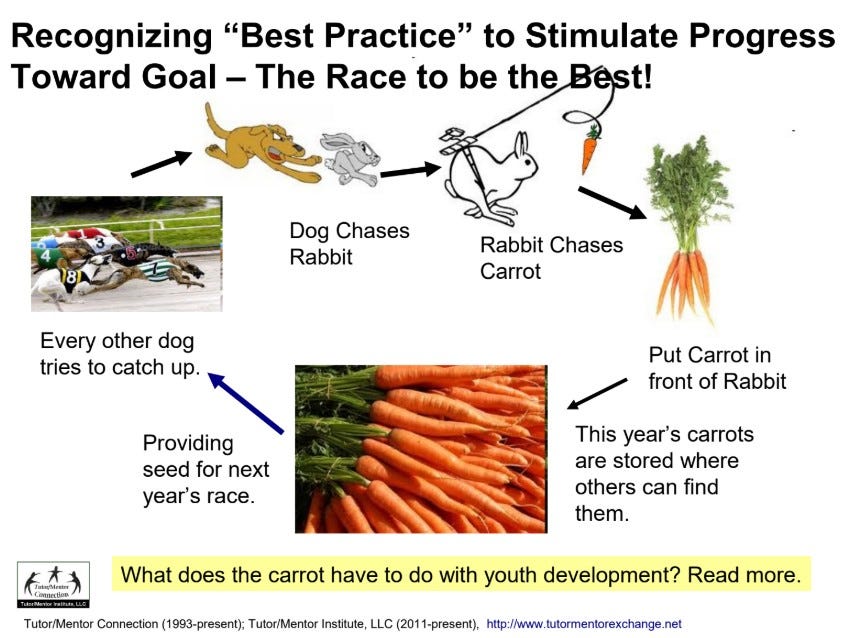
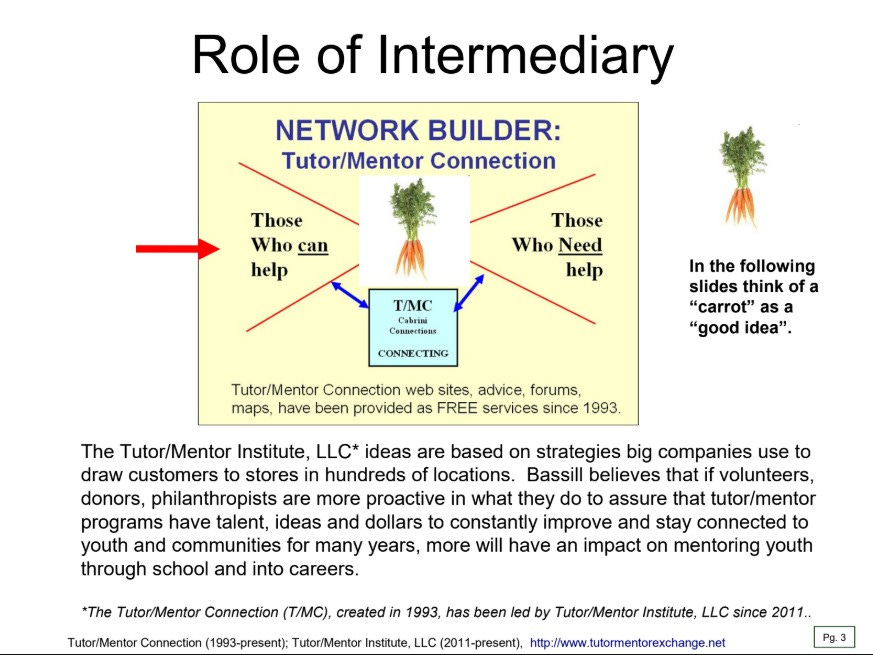
When I created the Tutor/Mentor Connection (T/MC) in 1993 the mission was to “gather and organize all that was known about successful non-school tutor/mentor programs and to apply that knowledge to expand the availability and effectiveness of these services to children throughout the Chicago region”. Read it here.
We were piloting the role of a “knowledge based intermediary” connecting “those who can help” with people and organizations who “need extra help”.
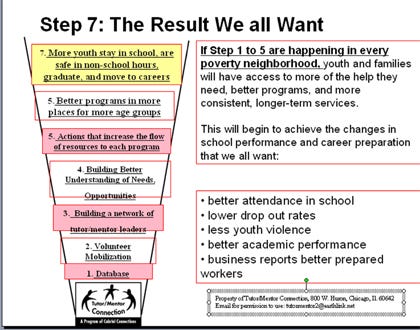
I’ve used the graphic below to illustrate the goal most of us want as a result of the work we do to help young people, as well as the work we need to do to achieve those results. I wrote about it in this article.
Since 2011 I’ve led the (T/MC) through the Tutor/Mentor Institute, LLC. Same goals. Different tax structure.
I’ve often tried to explain the purpose of the information I collect, by using the analogy of a “hospital operating room” where the operation is performed in an amphitheater where hundreds of others are watching.
I hope you’ll follow this progression of thinking, because it applies to helping cities like Chicago solve complex problems.
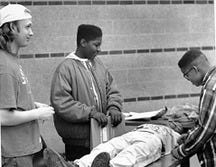
1) At the start of the “operation” two people are bent over a patient (a problem like violence?). As long as the expertise they both have is enough to do the operation, they continue. (This photo is from an improvisation workshop in spring 1993, during the first year operations of the Cabrini Connections program that I founded and led until 2011.)
2) However, as usually is the case, something occurs where the two doctors on the floor, don’t know the answer. They say to the audience, “Do any of you know how to solve this problem?” Someone says “I do” and they join the two on the floor. As this continues to happen, new ideas are brought to the operation and the group on the floor grows.
3) At some point, no one in the amphitheater knows the answer. However, someone says, “I know someone who does know the answer. I’ll find them and invite them to join the group.” Once that happens, the operation continues.
4) Eventually, a problem will arise that no one knows the answer, or knows anyone else who has ever dealt with that particular problem. Someone high in the gallery says, “I’m starting a PhD course at the local university. I’ll look into this and when I find an answer I’ll bring it to the group.” Several people, in universities, or in business, could be doing research on that problem.
I’ve been looking for people with experiences and information that could help people in Chicago build systems of support that help youth in poverty areas move through school and into jobs since I launched the Tutor/Mentor Connection in 1993. I’d been doing this informally since I started leading a tutor/mentor program at the Montgomery Ward Headquarters in Chicago back in 1975. Below is a map of the information in my “knowledge” library.
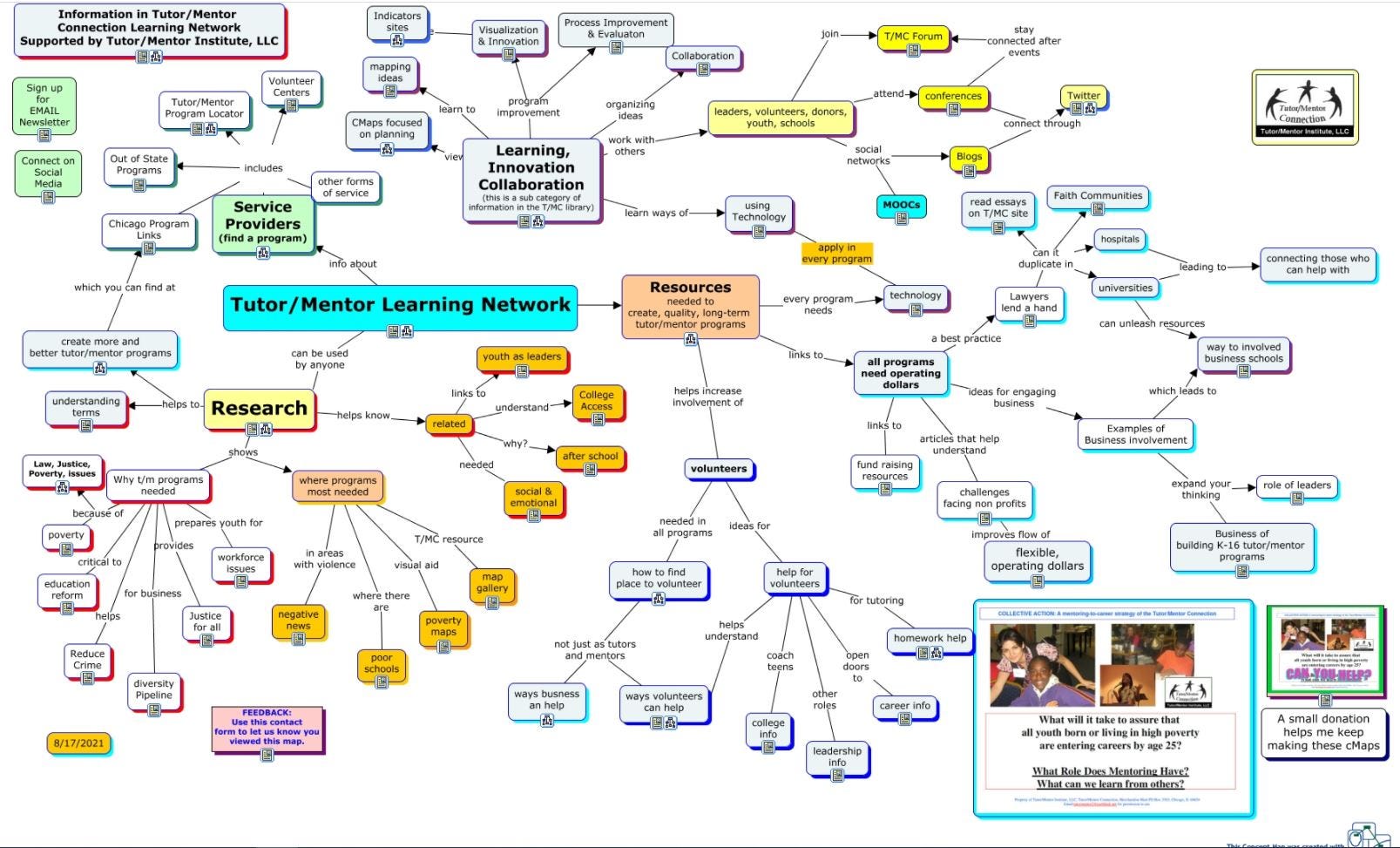
This information has been growing for more than 30 years. It’s been available to leaders in Chicago and other cities for that long. It went on the Internet in 1998. Yet, too few seem to value the role information has to support innovation and problem solving. That means when I go to events where people are gathering to “solve the problem” of education, violence, workforce development, health disparities, etc., few are even aware that my library exists.
The process does not effectively capture the knowledge of everyone in the room, or of others who may be in other cities and countries. Yet anyone could be building a web library, with links to ideas and resources they find valuable, and with links to other web libraries. This concept is outlined in the PDF showing the goal of a “Tutor/Mentor Learning Network” which I’ve been trying to build since 1993.
The critical idea in this PDF is that since few of us have advertising dollars, we need to take daily actions that draw attention to everyone in the network of information and ideas, not just to our own organization, no matter how powerful we are. As speakers have emphasized over, and over, “No one can solve this problem by themselves.”
I’ve devoted one entire section to collaboration, knowledge management, visualization, innovation, etc. You can enter it via this map. This section could be curriculum for school, or non-school, youth programs, where volunteers from business and universities help youth learn these skills, and learn to apply them in their own efforts.
One set of blog articles that I point to focuses on “online learning, MOOCs, etc.” The ideas in these sections can help enhance the process any group is using to solve Chicago’s problems, regardless of weather they connect with me or not.
That brings me to the graphic I show at the top of this article.
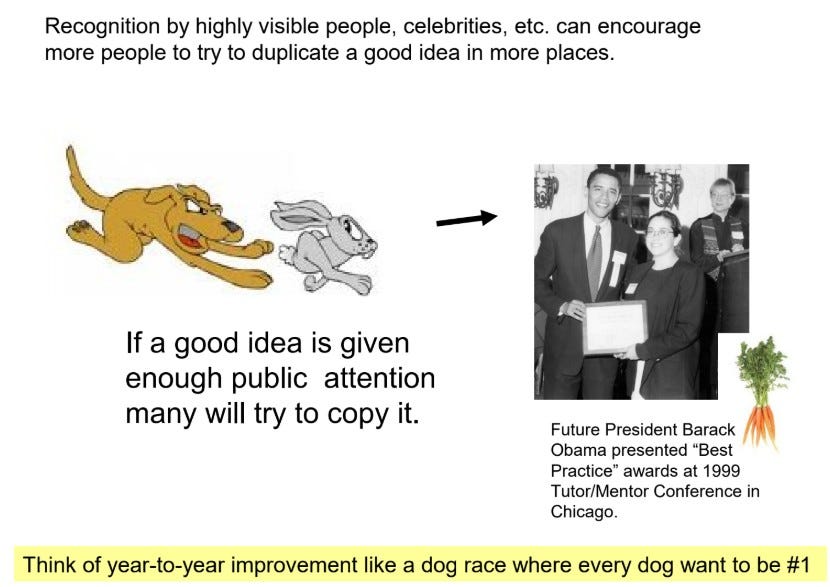
What does the carrot have to do with youth development? It’s the first page of a visual essay that I created in the late 2000s to illustrate the role knowledge, or work done by others, can take in supporting the constant improvement of work everyone is doing to help youth born in poverty move through school and into jobs and careers.
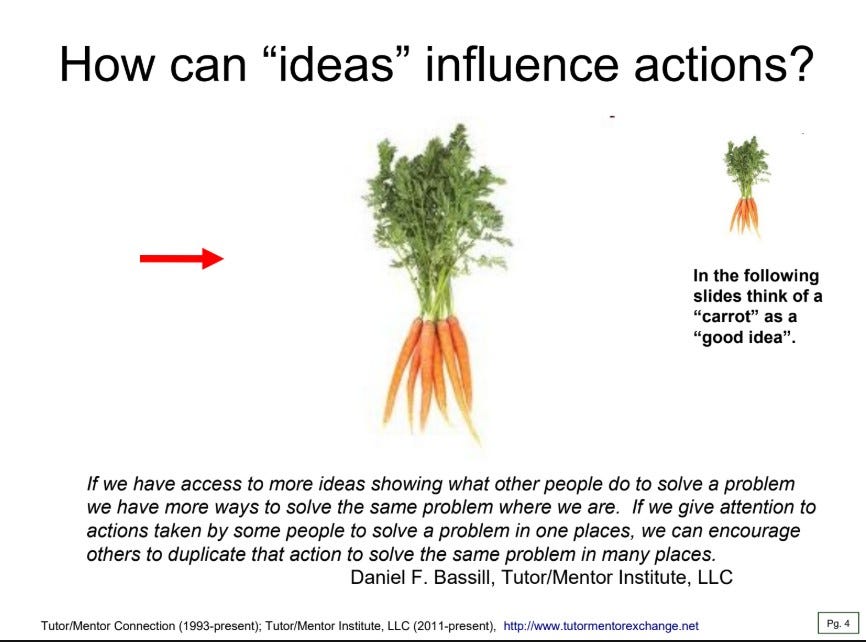
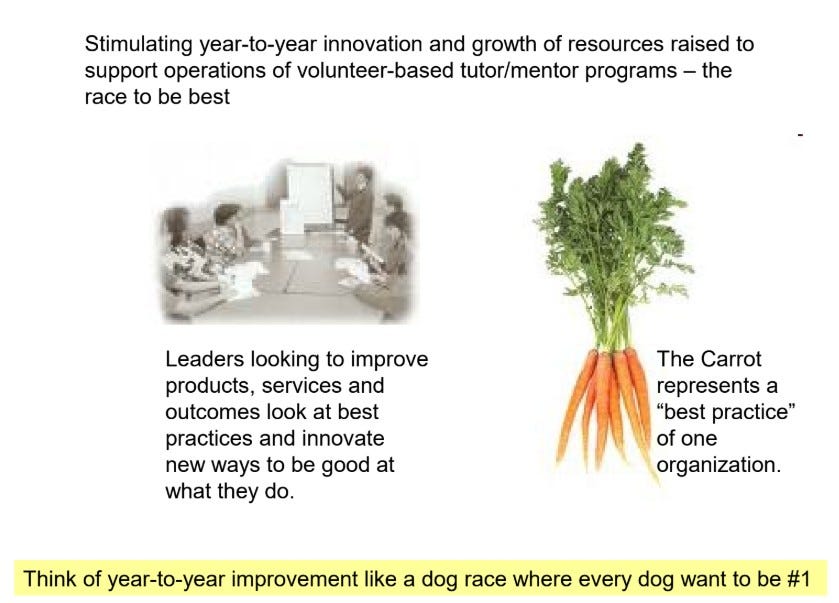
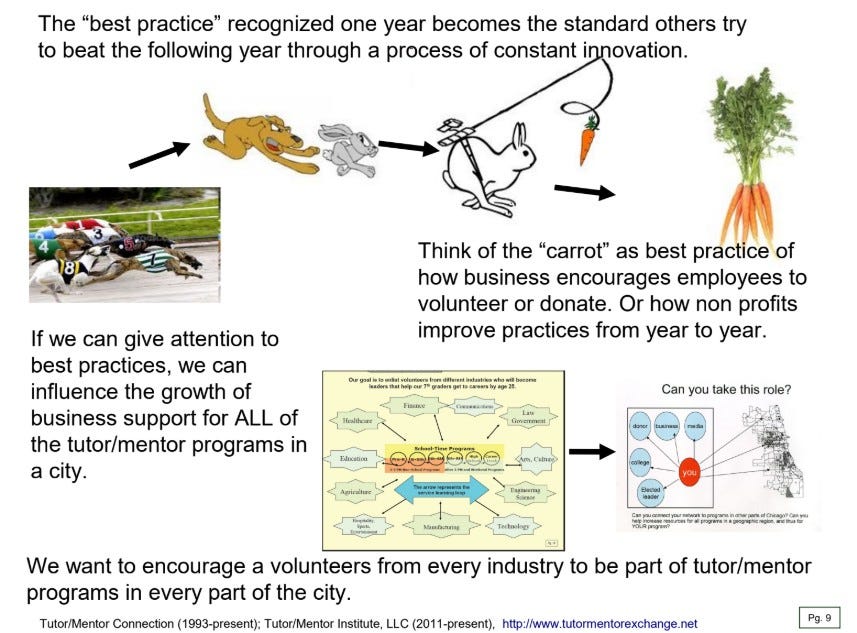
I’ve used the image of a “carrot” to represent a “good idea”. Someone who is inspired by the good work being done by others, is represented by the “rabbit” who is always looking for good ideas, or better ways to operate. In this graphic, the “rabbits” are the most aggressive innovators. The dogs, chasing the rabbit, are other organizations, who are following the example provided by “rabbits”, and trying to use the same good ideas to improve their own organizations.
So how might we stimulate year-to-year growth and improvement? Perhaps by thinking of “good ideas” as “carrots” that are used in a race where a rabbit chases the carrot, a big dog chases the rabbit, and a pack of dogs chase the lead dog.
My lists of Chicago volunteer-based tutor, mentor and learning programs points to websites of more than 200 youth serving programs. Some do better than others at showing their strategies, but collectively they represent a host of “good ideas”.
However, unless we find ways to motivate more people to dig into the library and look at these ideas, the value of building the collection is diminished.
So, over the past 30 years I’ve attempted many strategies to draw people to the library. Articles like the one you are reading now are an example of that.
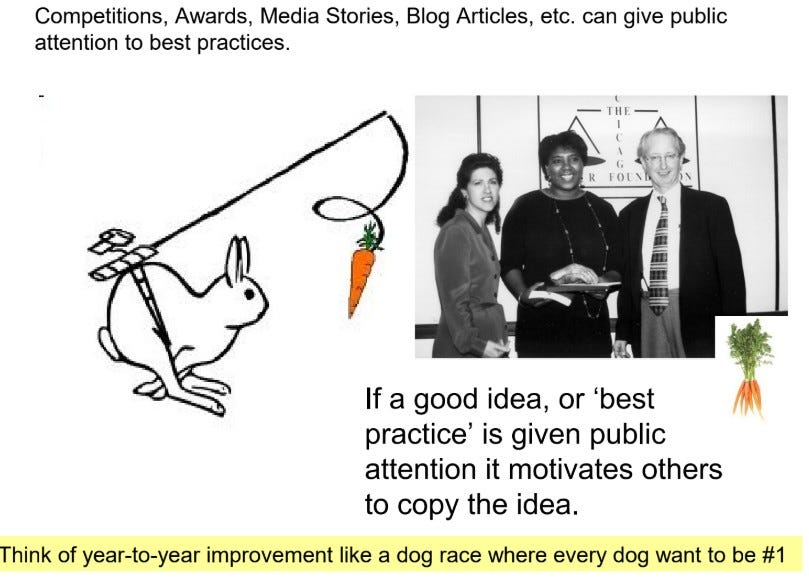
If a good idea is given a boost by high profile people, more will take time to look at it. You can see that I created this slide in 2008, just before Barack Obama took office. The photo was from a 1999 Tutor/Mentor Leadership and Networking Conference that I hosted in Chicago. He’s passing out a “best practice” award in the photo below.
If best practice awards were given annually, the winners of previous years could be models that programs use to innovate constant improvement, and future recognition as a “best practice”.
Libraries that collect great ideas can be a resource used around the world.
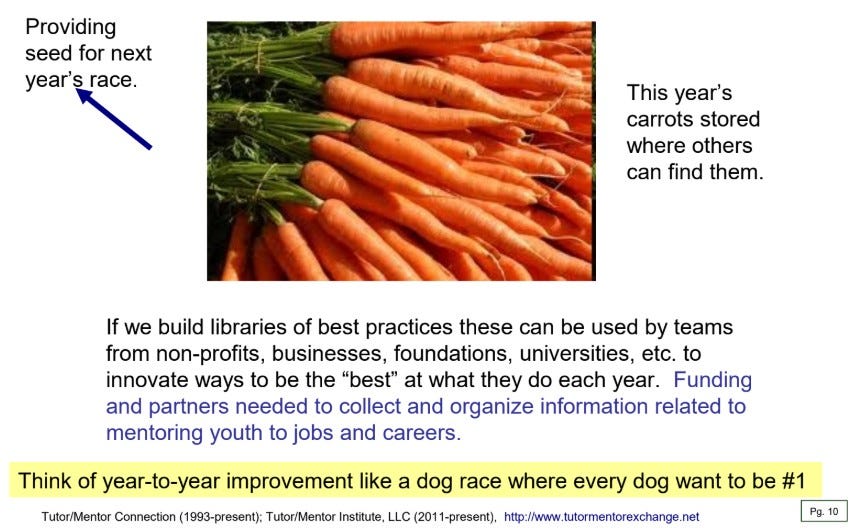
As I talk with people from other cities and other countries I encourage them to browse the www.tutormentorexchange.net site the same way they might look at all the stores in a shopping mall on their first visit. Later than can return to sections that they want to review in greater depth.
Since much of my library focuses on Chicago, I urge others to see if their city has a library like mine, and if they are using it the same way. If they do, I ask for the link so I can point to that site in my library, making it even more valuable to users. If they don’t have a resource like the Tutor/Mentor library, I encourage them to build their own, point to may library as one of the resources they share.
Starting a volunteer-based tutor/mentor program is easy. Recruiting kids and volunteers and supporting them each week during a school year, then motivating most to return for the next year is much more difficult.
I created this graphic to illustrate this challenge.
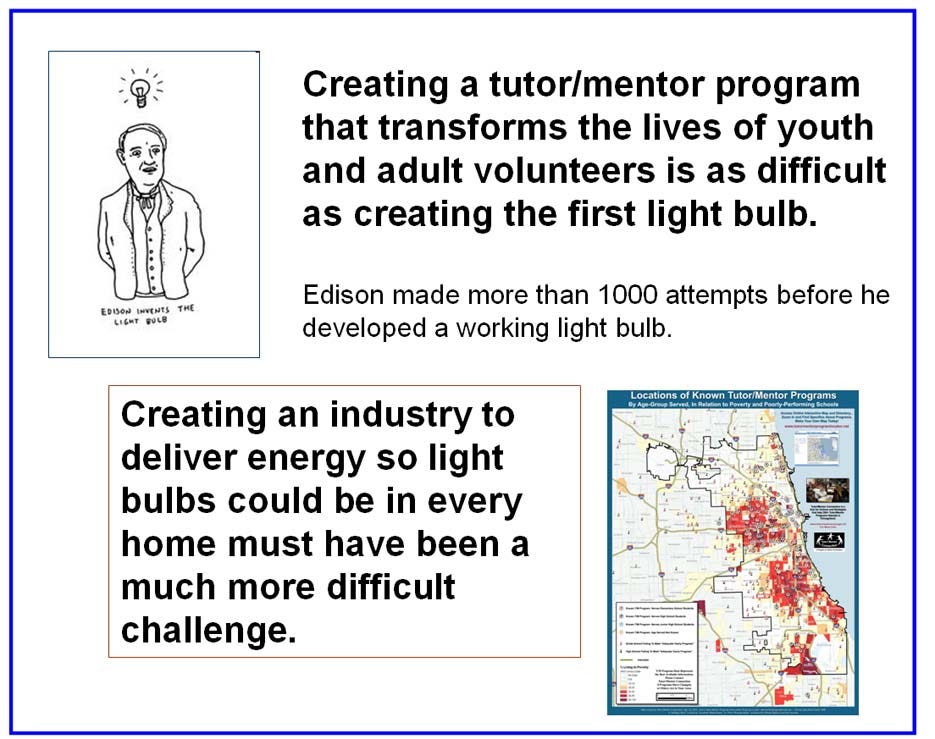
Creating and sustaining a single program for 10 or 20 years is a huge challenge. Making such programs available to K-12 kids in every high poverty neighborhood is an even greater task. Edison made more than 1000 attempts before he developed a working light bulb. Then he had to create an industry to deliver energy so light bulbs could be in every home.
Donors need to be proactive and consistent in funding constantly-improving tutor, mentor and learning programs so they can grow to be good, then great as they recruit youth who are in elementary or middle school and help them through high school, college/vocational school, and into jobs and careers.
One section of the Tutor/Mentor library focuses on philanthropy. However, I’ve no links showing cities or donors who support the strategy I’ve just described.
Maybe you can make that happen.
Thank you for reading. Visit this page to find links to where you can connect with me on social media.
Please help me continue to distribute this information by sending in a 79th birthday gift, or making a contribution through my HelpT/MI page.