Using knowledge base to solve complex problems
View elements of this concept map

I created this concept map many years ago to visualize how we were building a library of information that anyone can use to a) create and sustain volunteer-based tutor/mentor programs in high poverty areas; and b) understand root causes that created a need for tutor/mentor programs and placed challenges on youth and families that made it more difficult to move safely from birth to work; so (c) more people who first became involved as tutors or mentors would become involved in building solutions that reduced, or removed, these systemic barriers.
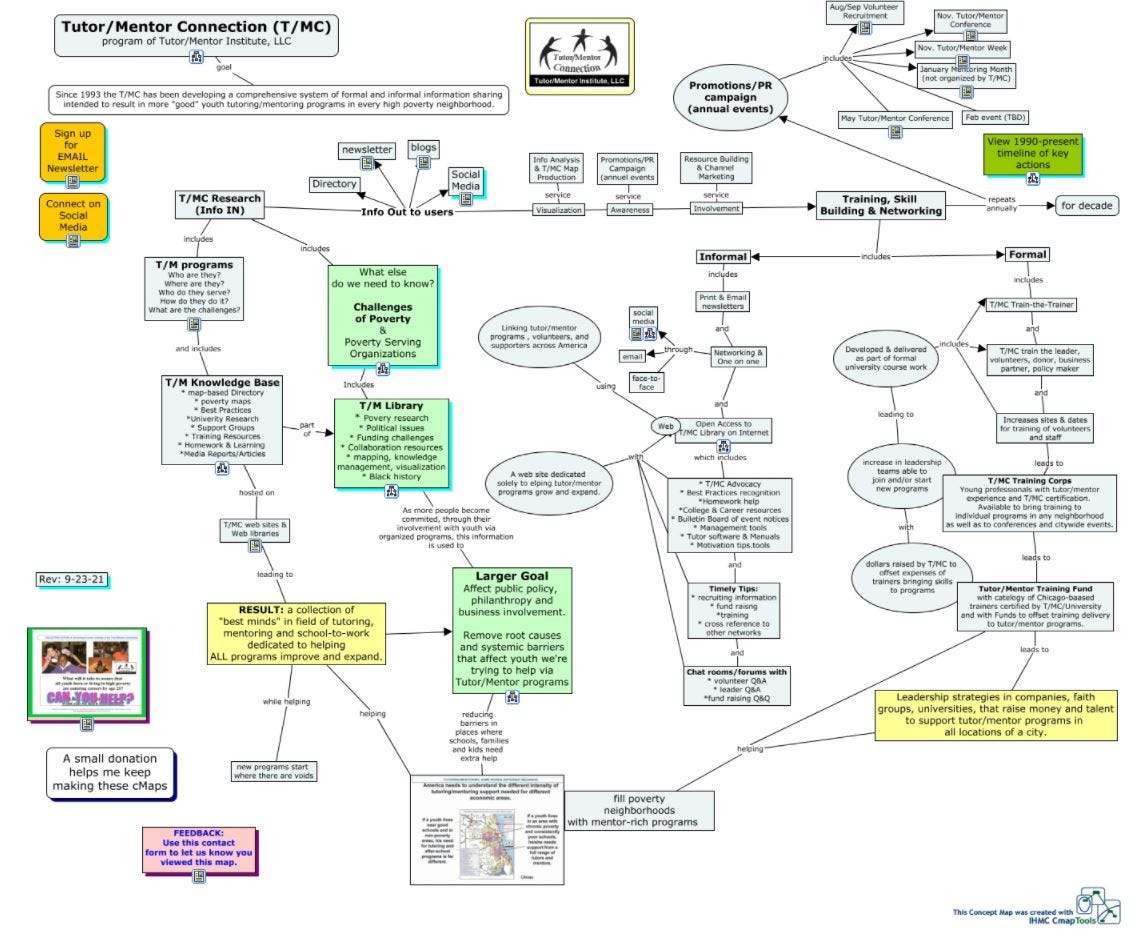
Below I'm showing some elements of this concept map. First look at the left side of the map.
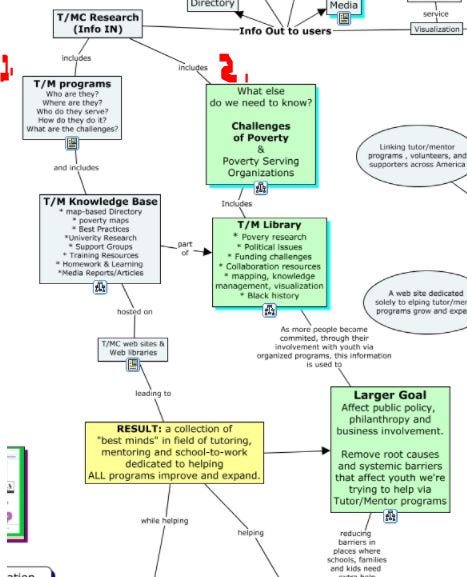
When I first created this chart I only included information that people could use to build and sustain volunteer-based tutor and mentor programs. (#1) on the graphic. I updated that with the set of green boxes (#2) showing that the Tutor/Mentor library includes a much wider range of information about poverty, racism, inequality, challenges of funding, ideas for learning, and ideas for collaboration, knowledge management, etc.
Just getting a youth into a tutor/mentor program is often not a powerful enough influence to assure a successful journey from birth-to-work. In high poverty areas there are many systemic barriers that need to be reduced, or removed. Getting more people personally involved in the work needed to understand, then remove the barriers, can be one by-product of getting more people involved as tutors/mentors and leaders in organized youth programs. My own 50 year journey is an example of that.
The right side of the concept map shows two forms of learning, one formal, and the other informal.
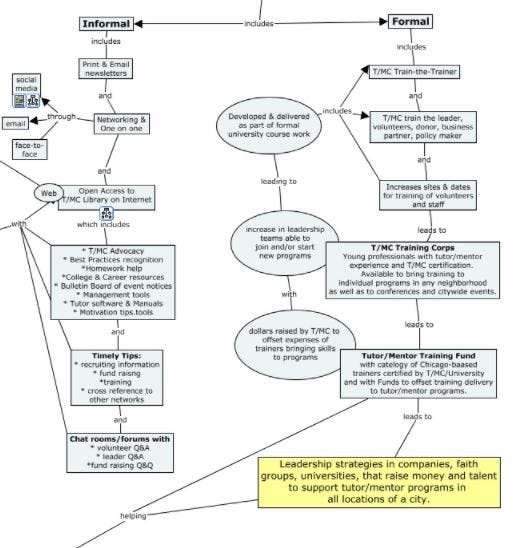
Each are intended to support volunteer involvement that leads to a better understanding of the information in the library and the growth of more and better tutor/mentor programs in places where they are most needed.
It also results in more people working to create systemic changes where those are needed.
Now look at the line across the top of the concept map.

Building the library is an on-going process, but it's only the first step in our 4-part strategy (which I described in this article). Getting people to look at the information in the library is an advertising and public awareness effort.
Thus we published our list of programs in a printed directory from 1994-2002, then in an on-line map based directory through 2018. It's now available in an on-line list and a Chicago programs map. Since 1994 I've used newsletters, blogs, social media, along with conferences and media events to draw attention to the library.
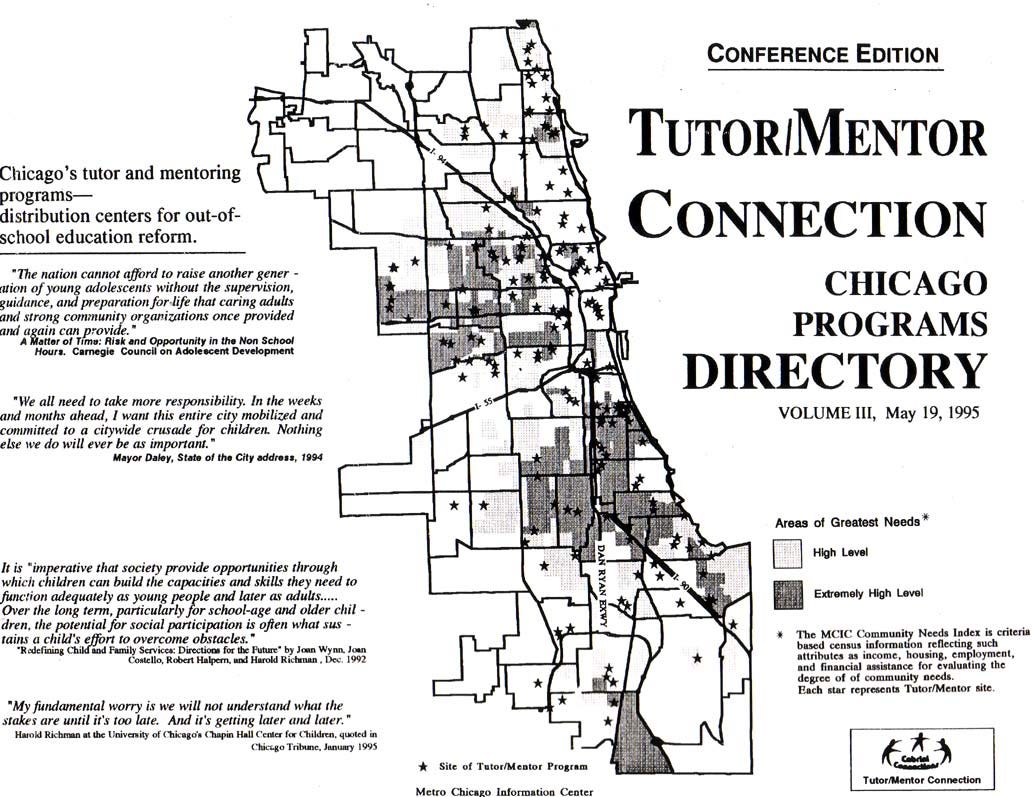
We began to use GIS maps in 1993 to show where tutor/mentor programs were most needed and where existing site-based programs were located. We also started a "rest-of-the-story" strategy using maps to show where media stories focused on incidents of violence, or locations of poorly-performing schools. We used these to show what assets (business, university, hospital, etc.) were in the area where the incident took place, who could help tutor/mentor programs grow. This was part of our effort to draw greater attention to programs throughout the city.
We (#3) then organized May and November conferences to draw programs together to learn from each other and to provide information to help support volunteers and students in every program. This information was part of on-going formal and informal learning. We organized annual August/September Chicagoland Tutor/Mentor Volunteer Recruitment campaigns to help programs find volunteer talent.
These events helped generate the media stories shown on this page.
Finally, we repeated this for 20 consecutive years.
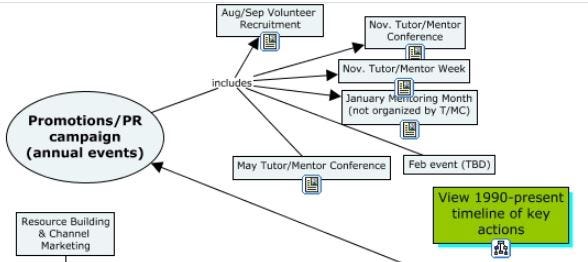
At the top right of the concept map I show events that we created in August, November and May to draw programs together and draw attention and resources directly to programs. The May and November conferences were held every six months for 20 years. The Volunteer Recruitment campaign was a multiple-site event every year from 1995 to 2003 and has been an on-line activity, drawing attention to our on-line lists of Chicago area programs continually since 2003.
Ultimately my goal is that people from different sectors and different places are forming study and learning groups which draw from information libraries they find on line.
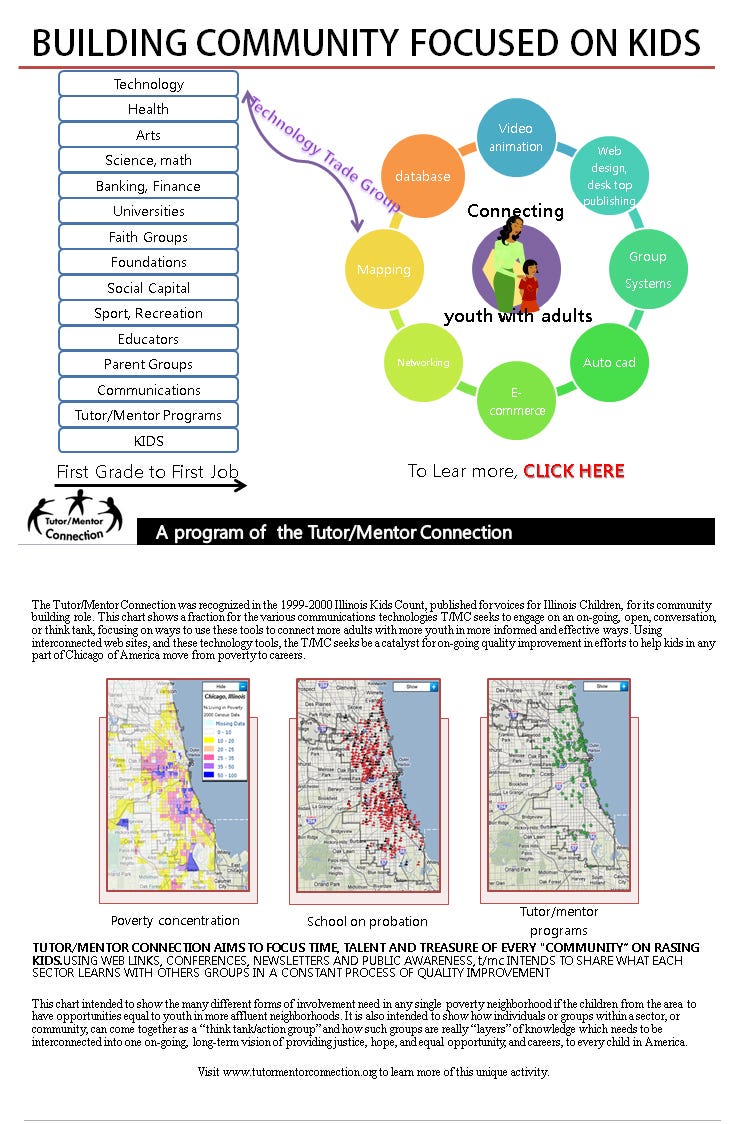
While these groups engage in on-going face-to-face learning, they also engage in on-line conversations, with each other, and with people in other groups, expanding their understanding of problems and solutions and building relationships with people who who might help...
....all with the goal of filling high poverty areas with needed programs and services that help kids move safely through school and into adult lives, jobs and careers (see strategy map).
The graphic shown above was created by an intern from IIT in Chicago who was a student from South Korea. This blog article shows how she used one of my graphics as inspiration for her version.
I’ve been using my recent Substack articles to show elements of my concept maps, with the goal that students from many places will look at my collection and then create their own versions, focusing the strategies on their own communities.
A few days ago I found an interview on Mastodon.Social that I did in 2014. In it I described my use of concept maps and the overall strategy of the Tutor/Mentor Connection (1993-present) and Tutor/Mentor Institute, LLC (2011-present). Open this link to listen.
If you've read this far, thank you! I hope you'll visit some of the links and build your own understanding of the strategy I've piloted. I hope you understand how this supports my own on-going learning and efforts to do "better today than I was able to do yesterday" and how it can help others on the same journey.
While there are many intermediary organizations in Chicago and around the country who focus on youth well-being and do some of the things the Tutor/Mentor Connection/Institute, LLC, have piloted, I don't yet see anyone including all of these steps, especially the 4th, drawing volunteers and donors directly to individual programs in different places, supported by a library with as much information as is included in the Tutor/Mentor Library.
Nor do I find anyone using concept maps as extensively as I have since 2005 to visualize strategy, process and information available.
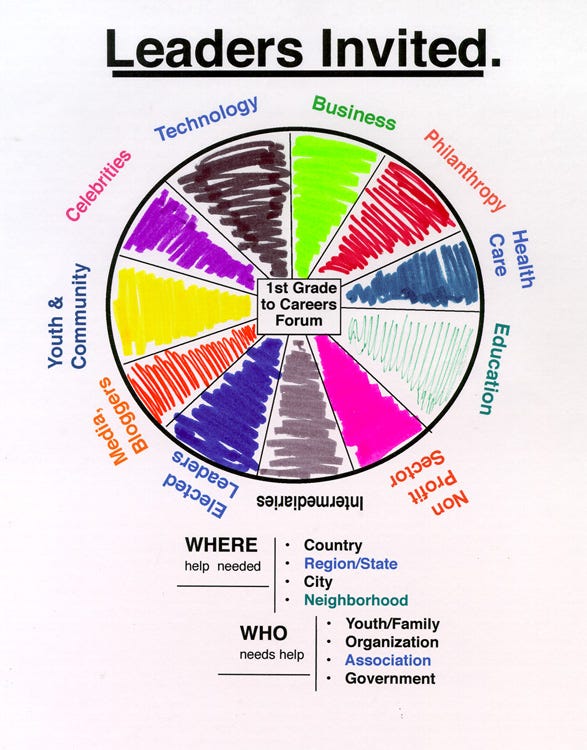
I have a Dream, too.
Almost every month I read about some wealthy donor giving millions of dollars to universities. I dream of someone making a $100 million commitment to one, or more, universities, to build a Tutor/Mentor Connection in every major city, supported by student/alumni teams from a local university. Here’s one article where I share this goal.
That needs to happen soon so I can pass on all of my archives and enable people to build from what I've started, rather than start from scratch.
Maybe by looking at the descriptions I’m providing they will better understand the strategies.
That won’t happen if they never see these posts. So please, share them!
This page show the many social media places where you can connect with me.
And, this page is where you can make a contribution to support my work.