
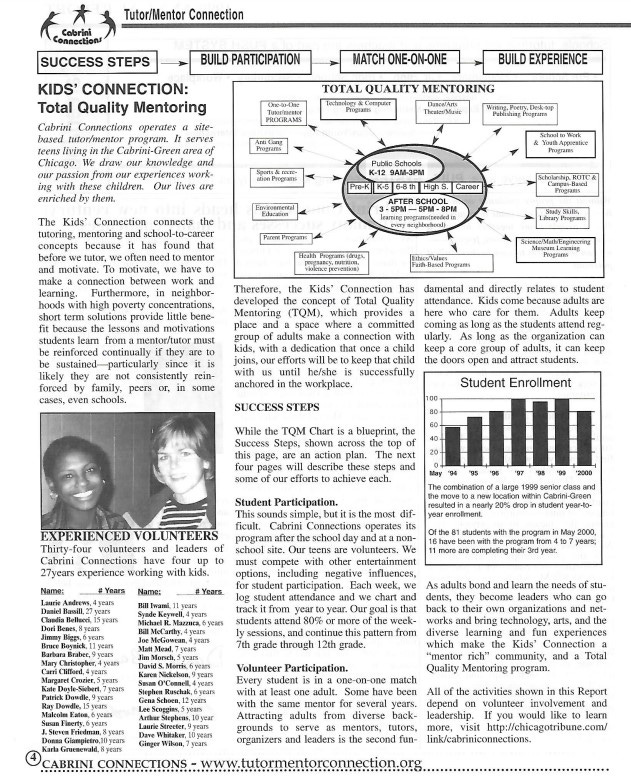
Below is a page from a 1999 Annual Report for the Cabrini Connections-Tutor/Mentor Connection that I formed in late 1992 and led until mid 2011. It features the hub/spoke graphic that I’ve used for over 30 years to describe a “mentor-rich” program that connects kids in high poverty areas with volunteers who come from a wide range of education and work backgrounds. View it here.
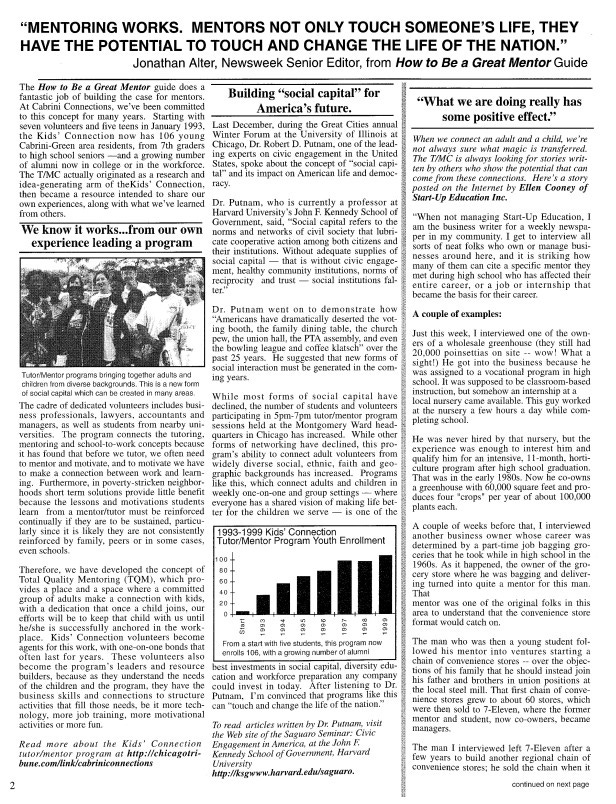
And below is a page from our 1999 newsletter. The headline is a quote from Jonathan Alter, Newsweek Senior Editor, that says “Mentoring Works. Mentors not only touch someone’s life, they have the potential to touch and change the life of the nation.”
Below that is a “Building Social Capital” for America’s future” article. I wrote this after hearing Dr. Robert D. Putnam talk about social capital. I realized then, and am still committed to the idea, that volunteer-based tutor/mentor programs are a strategy for building “bridging social capital”. View the PDF at this link.
I began reaching out to leaders of other volunteer-based tutor and mentor programs in Chicago in the 1970s, after I started leading the program at Montgomery Ward Corporate Headquarters in Chicago. I formalized that outreach in 1993 when we built the Tutor/Mentor Connection.
We launched our first survey to learn what tutor/mentor programs were operating in Chicago in January 1994. 120 programs responded, showing that they offered some form of organized, volunteer-based tutoring and/or mentoring. We used that list to create a printed Directory, which we distributed throughout the city. We also used it to invite people to gather and share ideas in May 1994 at the first Tutor/Mentor Leadership and Networking Conference. We used it to organize a Chicagoland Tutor/Mentor Volunteer Recruitment Campaign in August 1995.
I hosted that conference every six months until May 2015 and we organized site-based recruiting campaigns each year from 1995 to 2003. After that we created on-going volunteer recruitment by sharing our lists on line.
I’ve continued to maintain and share that list of programs since then (through the Tutor/Mentor Institute, LLC since 2011). You can find the list on this page.
Over the next six weeks every non-profit in the Chicago region, including tutor/mentor programs, will be seeking attention and year-end donations. I use my blog, newsletter, and social media to try to draw people to my lists, where they can choose programs based on what part of the city they serve, and what information they show on their websites. Here’s one example.
Some programs are much better organized that others. Some have greater ability to attract volunteers and donors. That’s why the graphic below is important.
As you look at existing programs in Chicago and other places, ask yourself “How can I help great programs stay great and how can I help other programs grow to be great? How can I help new programs form where more are needed?
By 1993 when we formed a new tutor/mentor program to help teens in the Cabrini-Green area move through school and beyond, I had already led a volunteer based tutor/mentor program for 17 years. I knew the potential of connecting caring adults with kids in high poverty neighborhoods.
I realized from the beginning that every program was different. Thus, my goal was to a) help each get extra attention, that hopefully helped each attract needed volunteers and operating dollars; and b) share program models from Chicago, the USA, and the world, that each program could use in an on-going process improvement effort. The conferences and the volunteer recruitment campaign were important parts of that strategy.
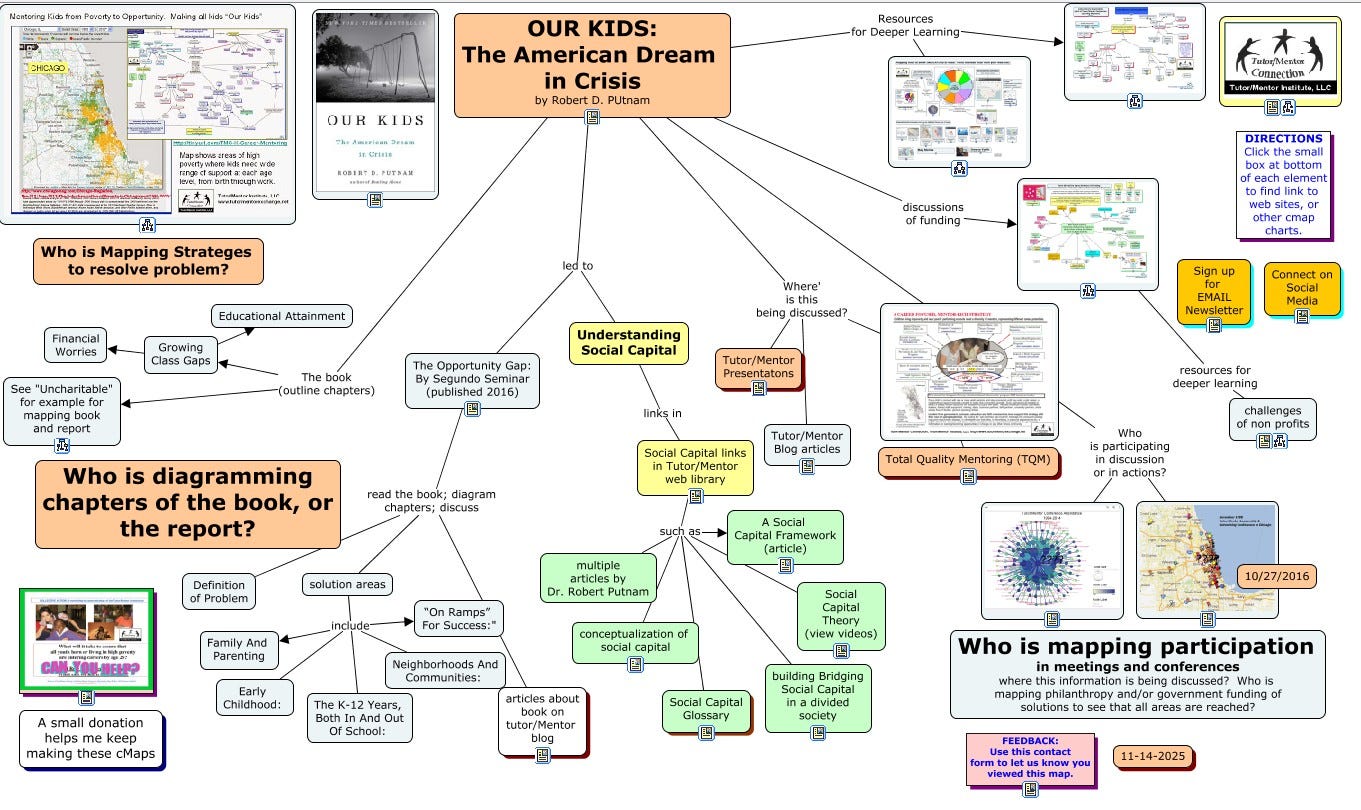
In 2015 after reading Dr. Putnam’s “Our Kids: The American Dream in Crisis” book I started writing a series of blog articles about social capital, which I’ve continued for the past 10 years. I also created a concept map that could be used as a study guide.
In forming the Tutor/Mentor Connection strategy in 1993 I realized that it would be difficult to change how program leaders operated their programs. However, based on my own experiences of volunteers coming to me saying “why don’t we try this”, I felt that if we could attract volunteers in different programs to the information we were sharing, many might be motivated to bring those ideas into their own programs, and provide time, talent and dollars to implement them.
Thus our efforts to get into Chicago print, radio and TV, and on the Internet after 1998, were designed to reach all levels of people involved with different tutor/mentor programs, including youth, families and donors!
Here’s just one of the stories that you can find on this page.
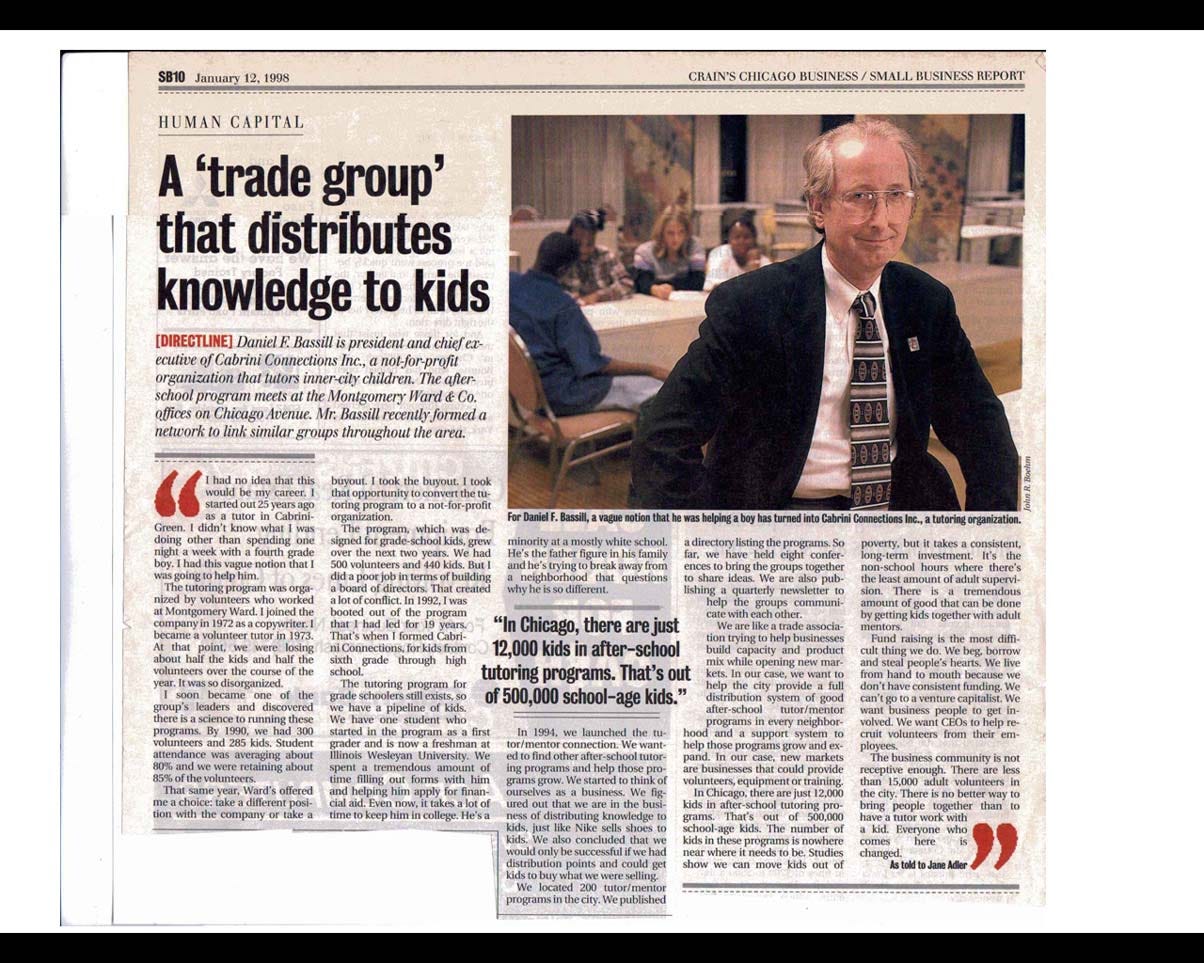
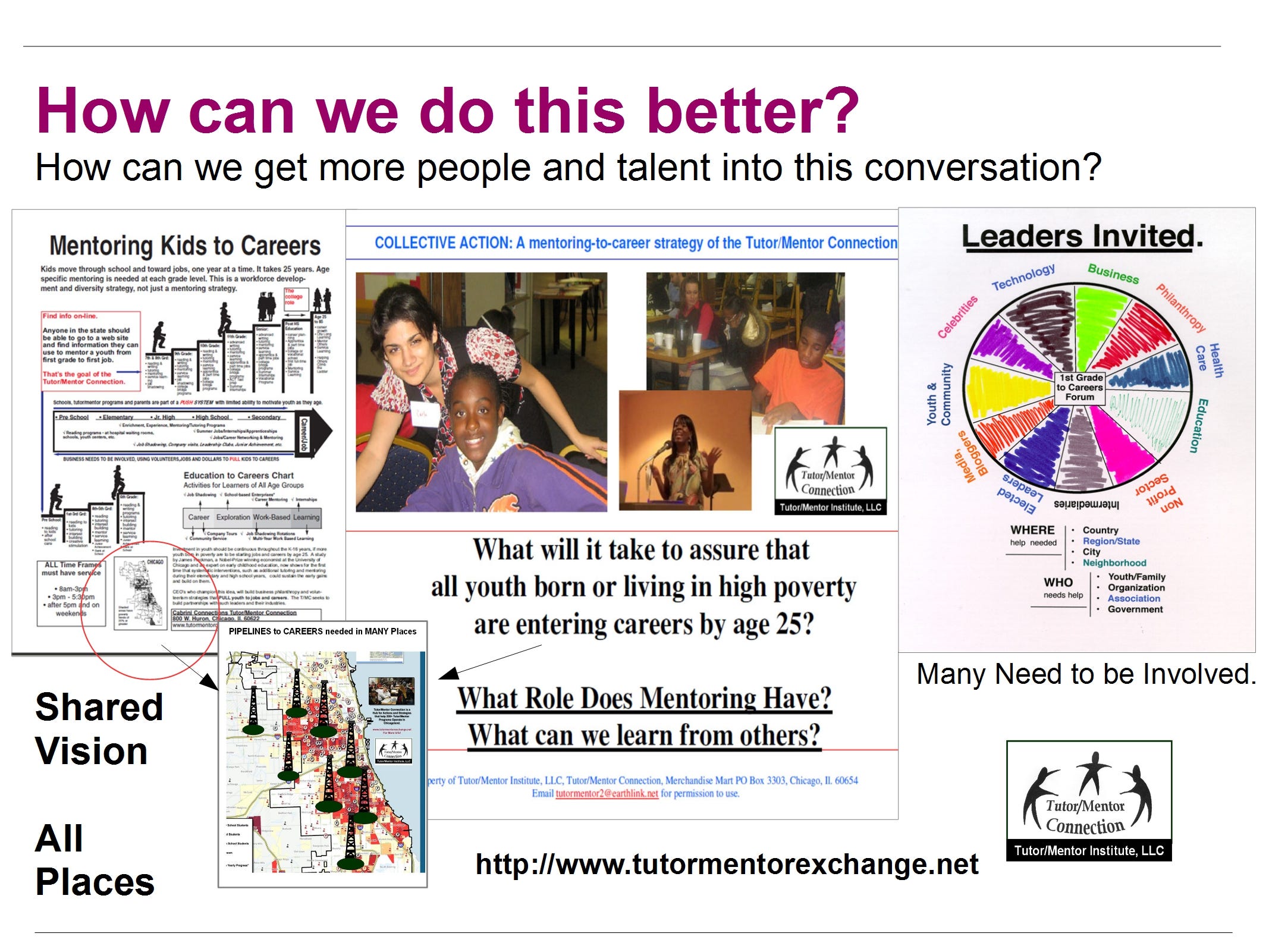
I’ve created dozens of visual essays and a few videos over the past 30 years to share these ideas. Below is a slide from this one.
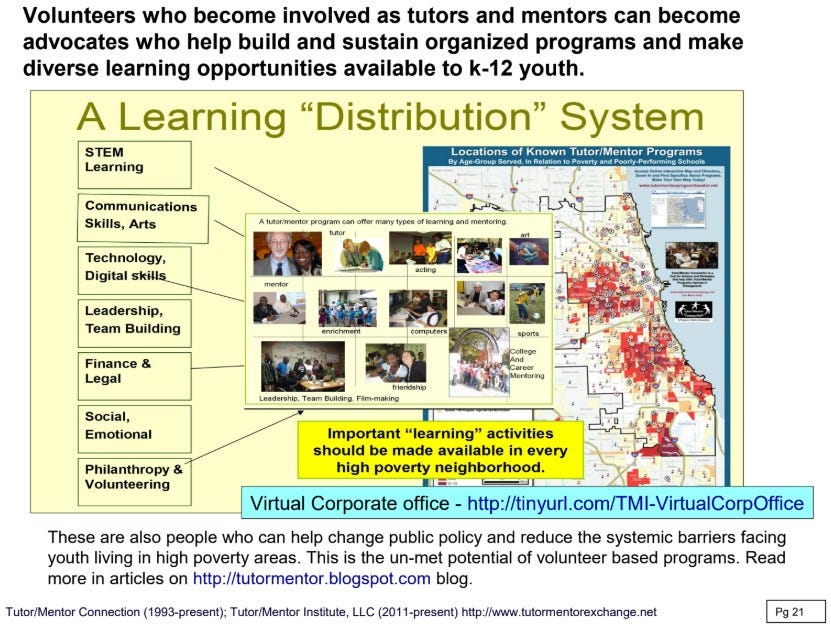
This visually sums up what I’ve been writing about. Volunteers who become involved as tutors and mentors can become advocates who help build and sustain organized programs. They can also help change public policy so more of these programs become available in every high poverty area, and they are strategically supported by business, professional groups, universities, hospitals and faith groups.
Any volunteer-based youth-serving program that is able to produce a graphic and/or video on their website, showing how youth are connecting with adults, is demonstrating a strategy of “building bridging social capital”.
The map of Chicago, showing high poverty areas, and locations of tutor, mentor and learning programs, is a core part of this strategy, emphasizing the need for on-going, constantly improving programs in every high poverty neighborhood, reaching every age group (elementary, middle and high school).
Here are a few more links to look at
Total Quality Mentoring explained - click here
How can we do this better? blog article
Follow up to Putnam talk in Chicago (2016) - blog article
Examples of using maps in blog articles - click here
I keep sharing these ideas with the goal that others will find them, reflect on what I’m saying, then apply some of the strategies in their own programs, and/or in how they support existing programs. If no one in your city hosts a website like mine, then borrow from my example and build your own Tutor/Mentor Connection-type strategy.
Thanks for reading. I’m on LinkedIn, Facebook, BlueSky, Mastodon, Twitter and Instagram. I hope you’ll connect with me on one, or all, of these platforms and help me share this information.
If you appreciate what I’m sharing, please look for the donation links on the left side of the www.tutormentorexchange.net home page.