
Below is one of three concept maps that I’ve created in past years to show why business should invest strategically in volunteer-based tutor, mentor and learning programs that reach K-12 youth in high poverty areas.
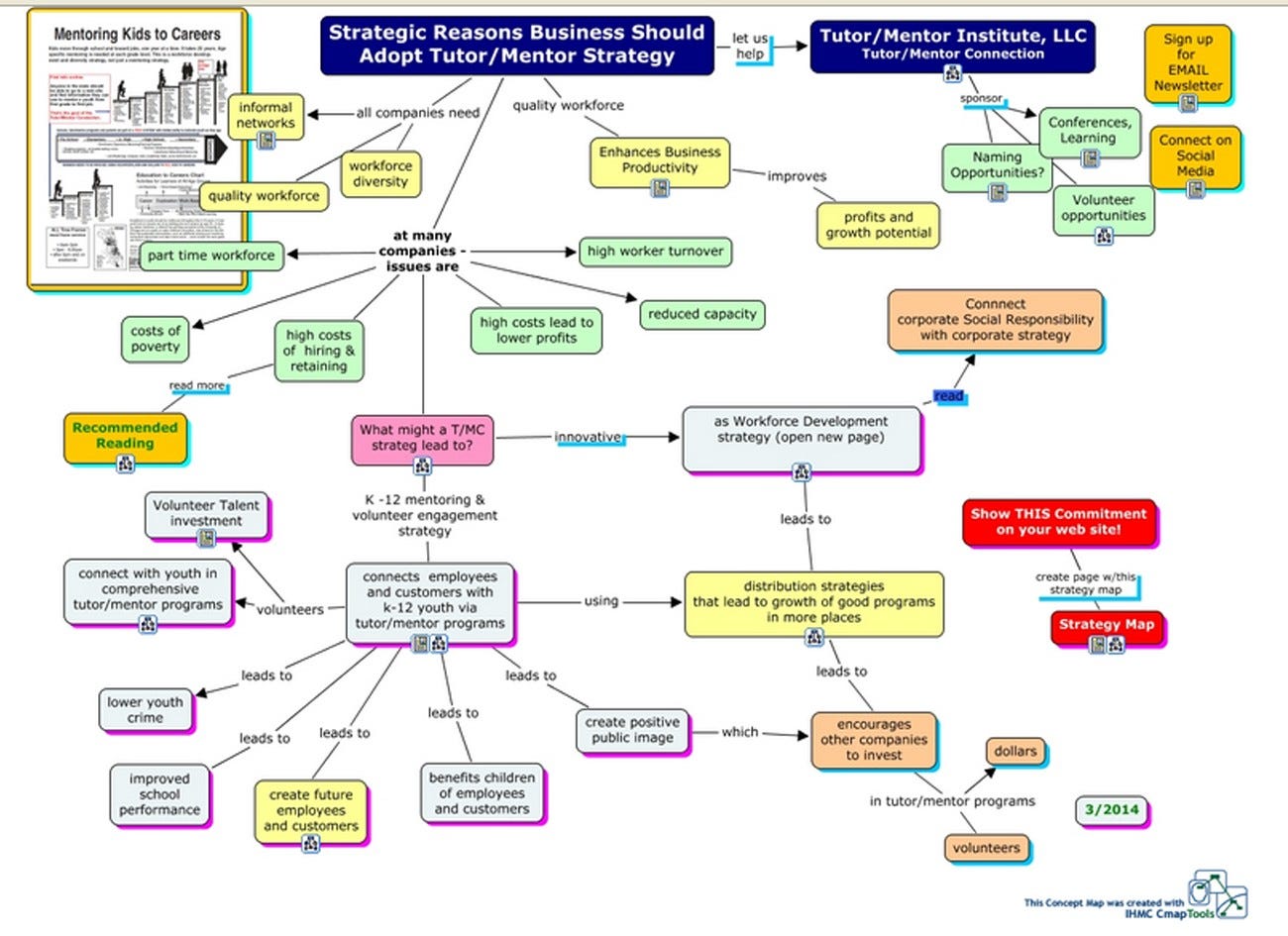
I included these in this article on the MappingforJustice blog. Today I asked Google Gemini to look at these and provide a fresh perspective. Take a look.
The concept maps hosted by the Tutor/Mentor Institute and highlighted in the “Mapping for Justice” blog at https://mappingforjustice.blogspot.com/2015/01/r-for-business-support-of-tutormentor.html offer a blueprint for a new kind of corporate leadership. At their core, these maps—specifically the “Strategic Investment by Business” map—argue that business involvement in youth mentoring is not just a “nice-to-do” charitable act; it is a critical strategy for workforce development and long-term economic stability.
The Executive Case: Why Business Leaders Must Map the Future
In the modern economy, “Corporate Social Responsibility” is often treated as a peripheral department. However, the concept maps titled Strategic Investment by Business and Workforce Development Company present a radical shift: viewing youth mentoring not as a charity, but as a long-term capital investment in the talent pipeline.
For a business leader, these maps represent a shift from traditional Corporate Social Responsibility (CSR) to a Strategic Investment Model. Here is a breakdown of the core ideas and why they belong in the C-suite.
1. Bridging the “Network Gap”
A central theme in the article “Maps, Time, and Social Capital” is that poverty is not just a lack of financial resources, but a lack of diverse social networks. Youth in high-poverty areas often have strong “bonding” capital (family and neighbors) but lack “bridging” capital—the links to people in different socio-economic circles who can provide access to jobs, internships, and professional knowledge.
The Strategy: When employee volunteers engage in organized, ongoing tutor/mentor programs, they serve as human “bridges.” They connect youth to a world of professional possibilities that might otherwise be invisible to them.
The Power of Connection: By expanding a child’s network to include engineers, accountants, or marketing managers, we are essentially giving that child the “who you know” advantage that is usually reserved for the affluent.
2. The 25-Year Pipeline: A Business Supply Chain
The maps visualize a critical reality: your future workforce is currently sitting in a third-grade classroom in a high-poverty neighborhood.
The Strategy: Instead of complaining about “skills gaps” at the end of the pipeline, the maps suggest businesses must invest in the infrastructure (tutor, mentor and learning programs) that keeps youth in the pipeline from elementary school through college.
The Logic: Consistent support (mentoring, technology, and safe spaces) reduces the high costs associated with poverty—costs that businesses eventually pay through taxes, crime, and a lack of qualified local workers.
3. Strategic Reasons for Adoption: Beyond the Checkbook
The “Strategic Investment” map identifies several competitive advantages for companies that adopt a comprehensive tutor/mentor strategy:
Employee Engagement and Growth: When employees volunteer as mentors, they develop soft skills—empathy, leadership, and communication—that are often difficult to teach in traditional corporate training.
Customer Loyalty: By connecting employees and customers with K-12 youth, businesses build a “brand of purpose.” This is particularly relevant as modern consumers increasingly choose brands based on their social impact.
Social Capital: The maps highlight the value of “networked employees.” A workforce that is engaged with the community is a workforce that is better connected to the realities of the market and more capable of driving social innovation. Read more about this in articles like https://tutormentor.blogspot.com/2022/04/maps-time-social-capital.html
4. Direct Impact: Tutors, Mentors, and “Social Capital”
The core of this strategy involves mobilizing employees to connect directly with youth in high-poverty areas. This isn’t just “giving back”; it’s an exchange of value.
Academic Support: Employee volunteers serve as tutors, closing literacy and STEM gaps.
Career Pathing: As mentors, employees provide “social capital,” offering the guidance and exposure to professional environments that many youth in isolated areas lack.
5. Infrastructure Building: The “Pro Bono” Advantage
A unique insight of these maps is that tutor/mentor programs are essentially small businesses. They need the same professional “scaffolding” that a corporation uses to scale.
Skills-Based Volunteering: Employees can use their professional expertise in Marketing, IT, Legal, or Operations to build the back-end infrastructure of the programs where they volunteer.
The Benefit: By strengthening the nonprofit’s management and technology, businesses ensure their financial donations have a higher “ROI” through more efficient program delivery.
6. The “Unpaid” Professional Development Benefit
Perhaps the most compelling reason for a CEO to adopt this model is the internal talent growth it fosters. When an employee volunteers—especially in an infrastructure-building capacity—they often step into “stretch roles” that aren’t part of their daily job.
Leadership Training: A junior staffer might lead a volunteer team, gaining management experience years before a formal promotion.
Cross-Cultural Competency: Working in diverse, high-poverty areas builds empathy and communication skills essential for a global market.
Problem Solving: Navigating the challenges of a resource-strapped nonprofit requires a level of agility and creative thinking that translates directly back to corporate efficiency.
7. Business as the “Lead Architect” of Social Change
Perhaps the most provocative idea in these maps is that Business must take the lead. The maps suggest that while schools are the primary educational centers, they cannot solve the complex issues of poverty alone.
The Gap: Business leaders are often frustrated by the public school system. The maps offer a “retail business model” for social change: using the non-school hours and the internet as a second channel for learning and career education.
The Tool: By using maps and data to see where programs are most needed, businesses can ensure their “treasure, talent, and time” are distributed where they will have the highest ROI for the community.
8. Moving from “Random Acts of Kindness” to “Strategic Distribution”
One of the related maps focuses on Public Awareness and Planning. It warns against the common pitfall of only supporting “brand name” charities.
The Leadership Takeaway: Business leaders should use these maps to evaluate their giving. Are they supporting a single program, or are they supporting a network of programs that covers an entire city?
Workforce Development: A strategic leader sees a tutor/mentor program as a “workforce development company.” If you wouldn’t run your business without a supply chain strategy, you shouldn’t approach your community’s future talent without a geographic and systemic map.
Conclusion: Business as the Lead Architect
The message to the C-suite is clear: Poverty is a business expense, and mentoring is a strategic asset. By aligning corporate “treasure, talent, and time” with the needs visualized in these maps, leaders can move from simple philanthropy to a legacy of systemic change.
Summary for the C-Suite
The message of these concept maps is clear: Poverty is a business expense, and mentoring is a capital investment.
Business leaders should read these maps because they offer a way to solve the “talent crisis” while simultaneously strengthening the communities where they operate. It’s a transition from being a donor to being a stakeholder in a child’s 25-year journey to success. By aligning corporate resources with the needs visualized in these maps, leaders can move from simple philanthropy to a legacy of systemic change.
I hope this makes sense to you and you’ll share the article. Better yet, I hope you’ll adopt the strategies and make them your own!
Furthermore, I encourage you to look at other articles on my blogs and in the www.tutormentorexchange.net library, and ask your favorite AI tool to rewrite it for you.
Last week I posted this article on Medium, with a sample speech that a CEO could give.
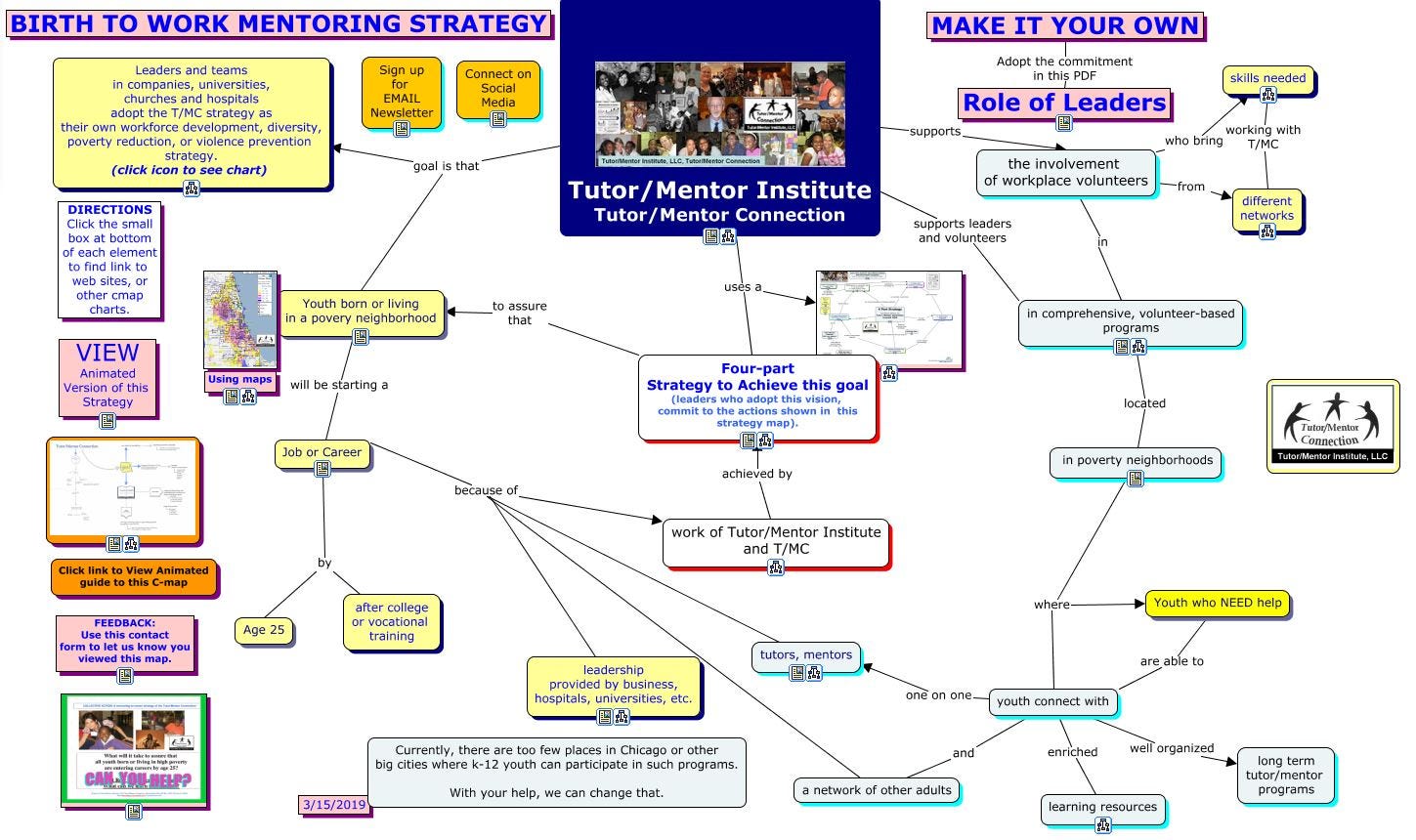
I think students, volunteers, parents and business leaders could look at any of my articles and turn them into their own presentations. Do it!
Thanks for reading this. Please connect with me on LinkedIn, BlueSky, Facebook, Instagram, Twitter and Mastodon and share your own strategies for building a pipeline of support that helps kids in all poverty areas of your community move through school and into jobs, free of the grip of poverty.
I don’t ask people to pay to read my articles or use the resources on my website, but do appreciate when people go to this page and make a contribution to help me pay the bills.