
I have seen many news stories over the past 50 years with the message “Enough is Enough”, meaning, “We’ve got to stop this”. In the late 2000s I turned that into a blog article, which one of my interns from South Korea turned into an animation.
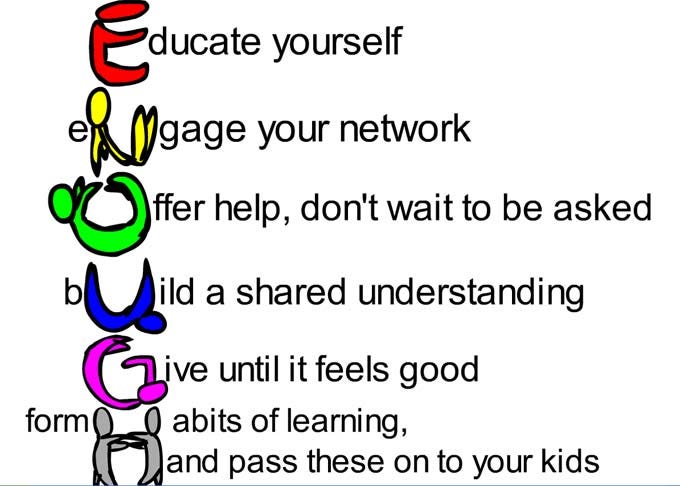
This animation was done in 2011 by Sam Lee, one of my interns from South Korea, after reading this article.
In my previous posts I’ve shared ideas for helping kids in high poverty areas move through school and into adult lives, jobs and careers. Media stories regularly remind us of the problems kids and families face.
They now also remind us of challenges to our Democracy.
If we want to stop the violence against kids, and against Democracy, we have to act now, and keep acting to solve these problems for many years. We have to think spatially, that is, look at the entire city and suburbs, our state, other states, and other countries, not just one neighborhood.
At the same time, we need to act locally, because none of us has the time, or the resources to help each of the kids in the entire Chicago region who live in neighborhoods where poverty is the root cause of the violence.
Here are some ways to remind yourself. Think of ENOUGH, is ENOUGH
E – educate yourself – most of us do not live in high poverty neighborhoods, so we only understand the root causes of senseless shootings from what we read in newspapers. We also only read negative news in the media, so we’re not really well informed on where these events are taking place most frequently. Finally, while there is a perception that there are plenty of youth programs, we really don’t have a good understanding of the distribution of different types of youth programs, to different age groups, in different zip codes. The only way this will change is if each of us pledges to spend one hour a week reading books, articles and web reports, that illustrate the root causes of these shootings, or of poor performance in schools. Through our learning we can draw ideas that we use in our own actions. We can also begin to contribute information that other people use to support their own decision making.
To help with your learning about race, poverty and inequality in America browse the different sections of the Tutor/Mentor library, shown on this concept map.
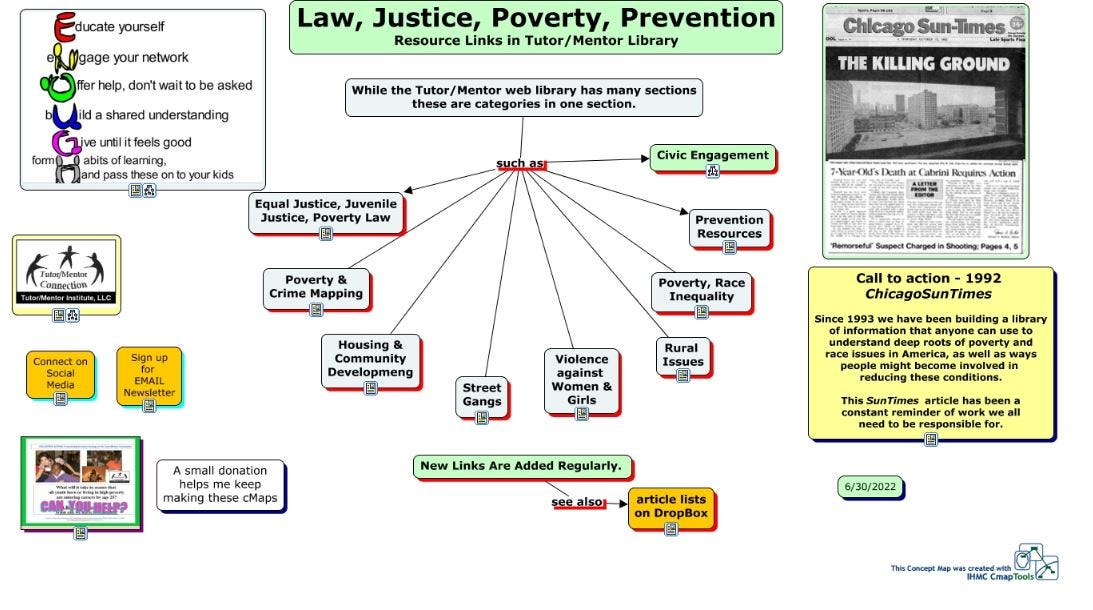
It’s really important to understand what drives people to vote for Trump and his enablers. Many of the articles and websites that I point to from this concept map, provide information that will help you better understand the challenges facing youth, families and schools located in areas of concentrated poverty. A similar library could be created to aggregate research and articles that help us better understand what fuels support for Trump and other fascists leaders. (I’ve already started that. Look at the articles I’m sharing on this DropBox page).
Another library that is needed would be one aggregating information about immigration, and showing ways to create a legal path for people from different countries to enter the USA and seek a brighter future.
If you host either of these libraries share a link in the comments and I’ll add it to my own library.
N – engage your network – find ways to draw others who you know into this shared understanding. Recognize people who volunteer time and talent, or who help kids through the programs they operate. If you are a business leader, or a church leader, engage your corporation or your congregation. You can use your web site, advertising, point of purchase materials, etc. to point to websites that show all of the agencies in the city who do tutoring/mentoring, such as www.tutormentorexchange.net. If you do this weekly, year after year, your friends, coworkers and customers will become involved in solving this problem with you.
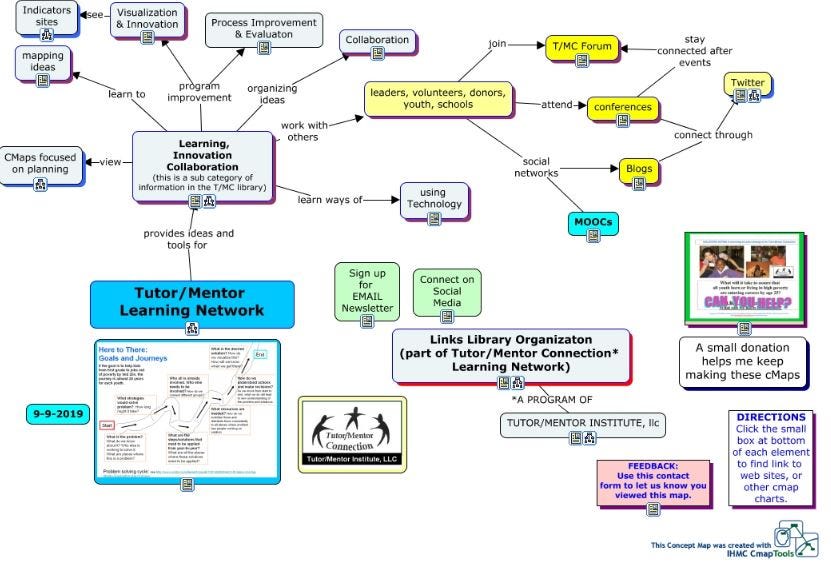
This concept map shows another section of my library. The links point to resources on collaboration, community building, innovation, knowledge management, etc. These are skills many should learn, in order to build and sustain the coalitions needed to not only remove Trump and his enablers, but to address the root causes and social injustices that fuel voter ager and disengagement.
O – offer help, don’t wait to be asked. As you build your understanding of where poverty is most concentrated, and what social services are in those areas, choose a neighborhood, and reach out with offers of time, talent and dollars. Help build a web site, do the accounting, or offer Public relations services. Help raise needed dollars, or give generously from your own resources If the website of an organization shows they do good work, you don’t need to ask for a proposal of how they would spend your donation. You need to send them a donation so they can keep doing that good work.
Apply the same practices to help political leaders mobilize voters, then stay accountable to them once they are elected.
U – build a shared understanding. Form groups of peers to share reading and learning assignments, just as many of you meet every week to read passages of scripture and build your group’s understanding of the word of God. Use the many different resources of the Tutor/Mentor Connection/Institute, LLC Links library as the starting point for your search for wisdom, and understanding.
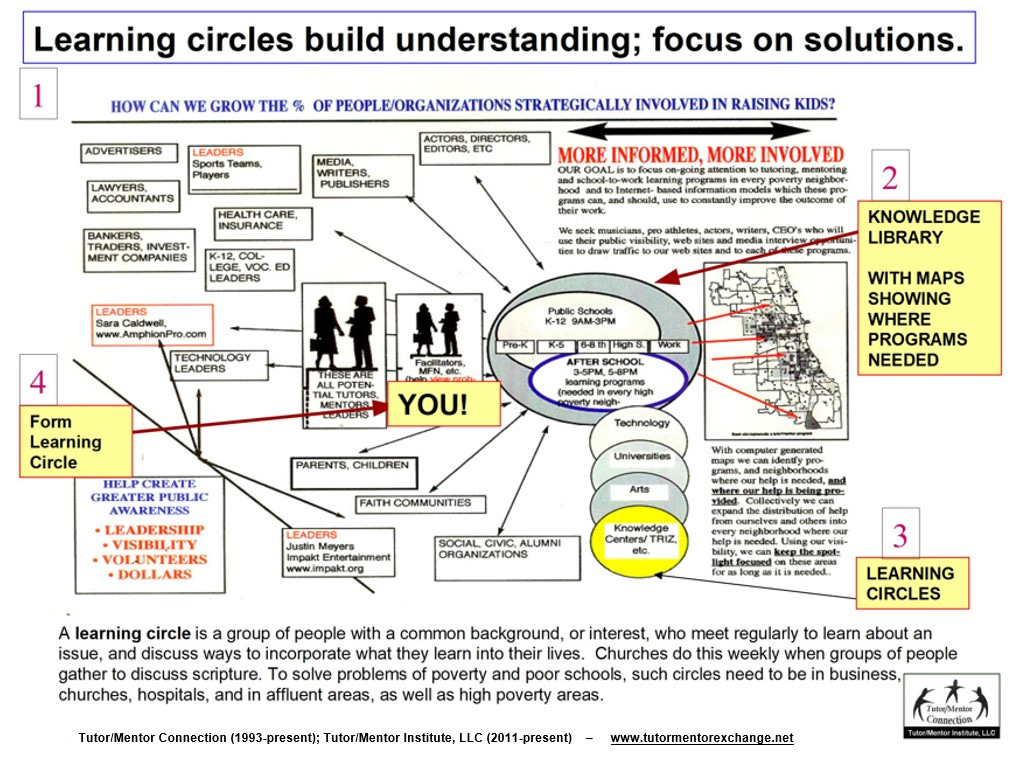
In the concept map shown above you’ll find one node pointing to concept maps that show political engagement resources. When/IF we defeat Trump and regain control of the House, Senate, White House and Supreme Court, we need a complete revision of how people are elected and how they represent the people who voted for them, not the people who have given them tons of money. Here’s one of those concept maps.
G – give until it feels good – people who generously donate time and dollars to causes they believe in feel good about their giving. If we’re going to surround kids living in poverty dominated neighborhoods with extra learning and adult mentoring networks, donors will need to give more than random contributions of time, dollars and talent. And they need to repeat those donations annually, for many years!
Political campaigns are expensive. Pick a few candidates and support them. I do my political giving through a website hosted by Charles Gaba.
H – form habits of learning, and pass these on to your kids. Imagine how much more successful teachers would be if youth came to school every day asking questions about where to find information, or how to understand information they had researched on the Internet the previous day? We can model that habit if we build it into our own activities. Keep a chart where you can document actions you take each week to be sure that this time ENOUGH, really means ENOUGH.
If you document actions, you can review what you’ve done at the end of each month, and each year, and begin to see a growing mountain of actions you have taken to solve this problem. Some of these will be actions that got other people involved, so that the good work you do is multiplying because of the good work others are also doing.
Through this process you help build this shared understanding, which will lead to better public policy. Without this habit of learning, and without learning to use the Internet to find good ideas from people in all parts of the world, we won’t be able to problem solve as well as we need to, and we won’t be able to teach this habit to our kids.
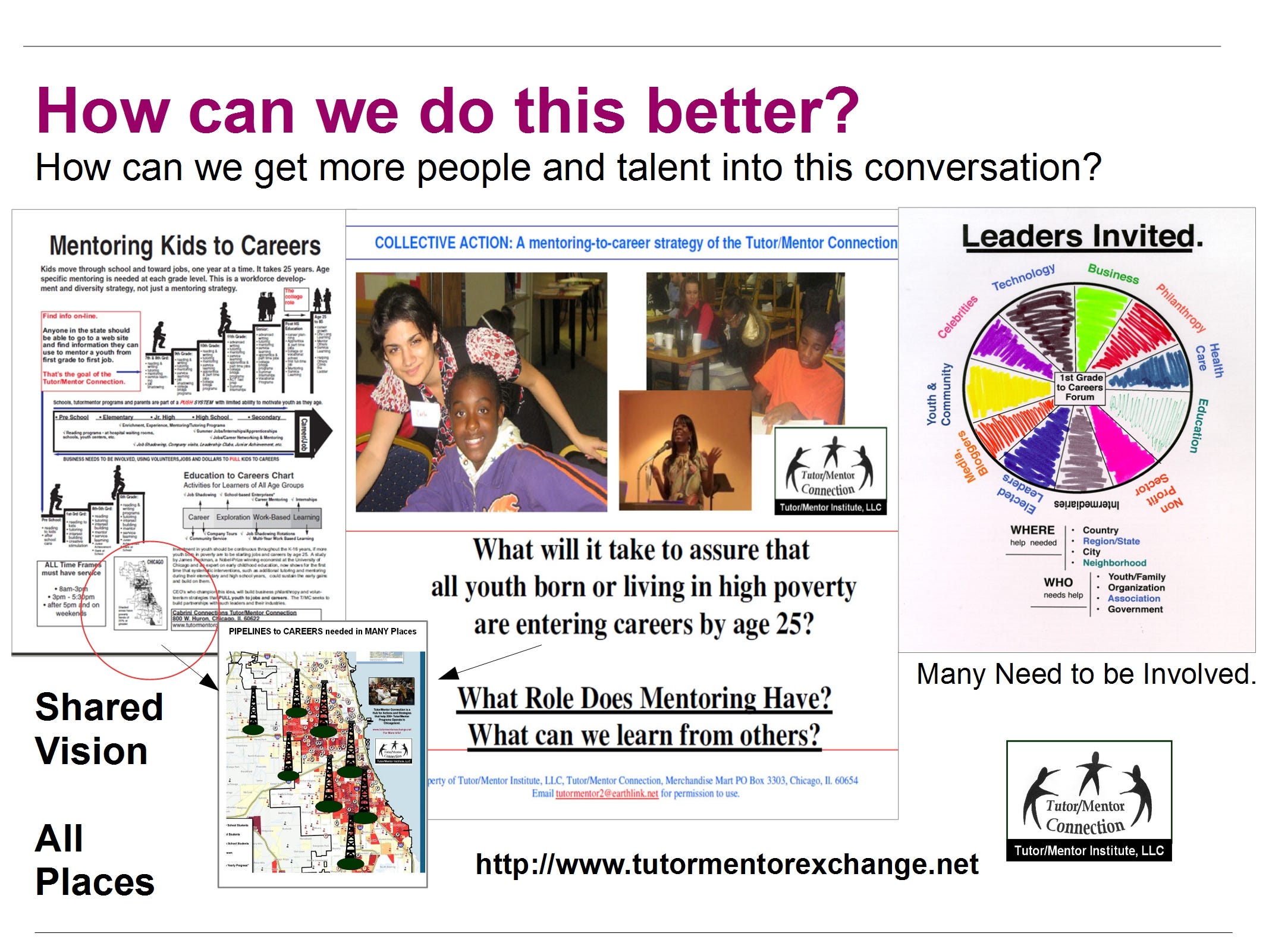
I’ll finish with this thought. How can we do better?
View the “Enough is Enough” animation in this article.
Thanks for reading. Please share my posts. These won’t make a difference if too few people see them, and too few people act on what they see.
I’m on LinkedIn, BlueSky, Twitter, Facebook, Mastodon and Instagram. I hope you’ll connect with me.
Finally, the work of building and sharing information libraries like I’ve pointed you to needs to be consistently supported. If you’re able, visit this page and make a contribution to help fund my work.