
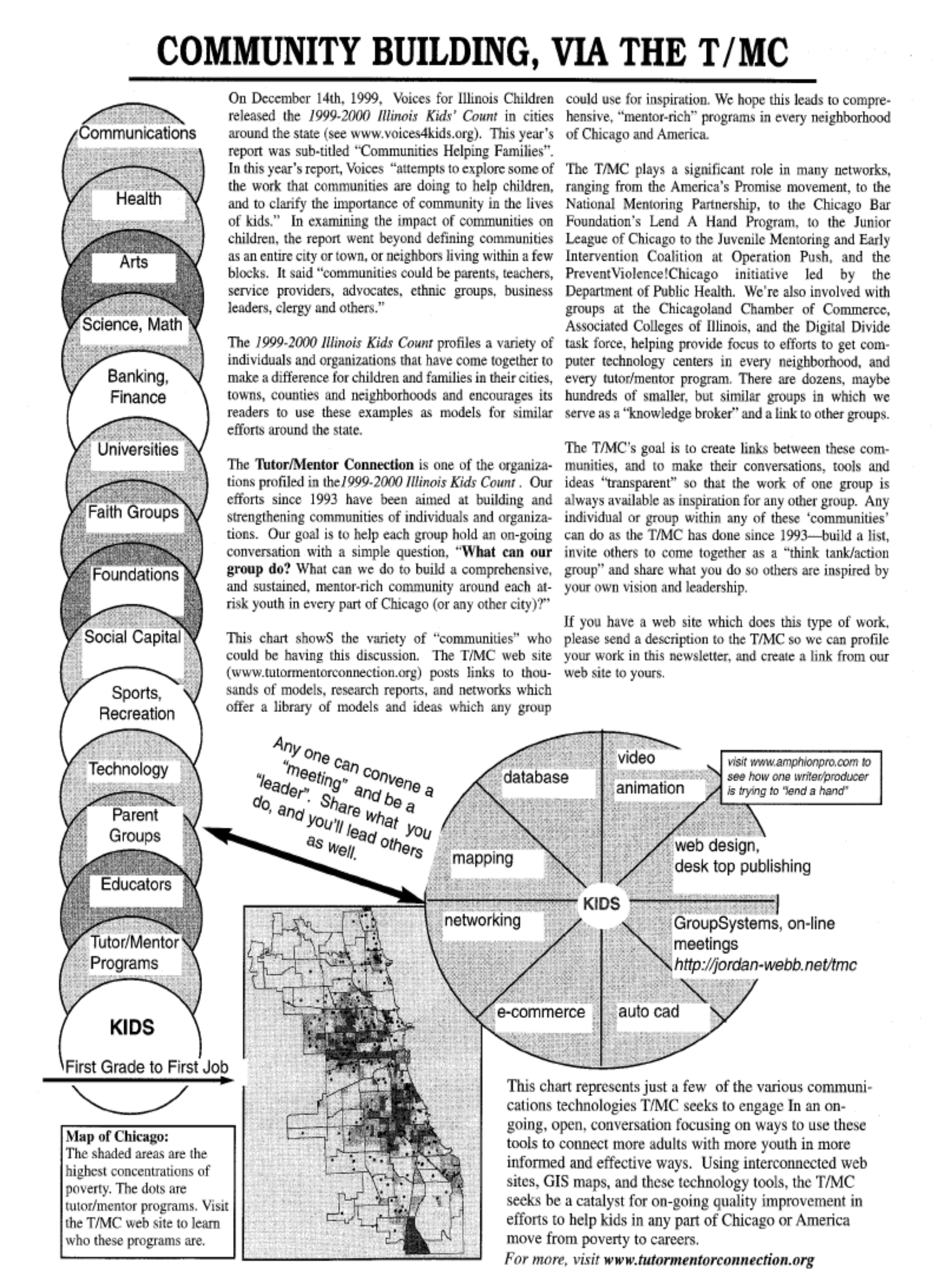
This is a page from my Spring 2000 Tutor/Mentor Report newsletter. It was sent to about 12,000 people.
If you were to look at all of my newsletters, social media posts, blog articles, etc. that I’ve posted since 1993 you would find many efforts to motivate leaders to adopt the role described in this newsletter.
Too few have seen this. So I tried again.
In this Medium article you can read a "speech” given by the CEO of a Chicago manufacturing company, championing this idea. You can also listen to it.
This was created by Google Gemini, after several prompts from me.
I began by asking it to look at the concept map shown below, then to describe what it is showing.
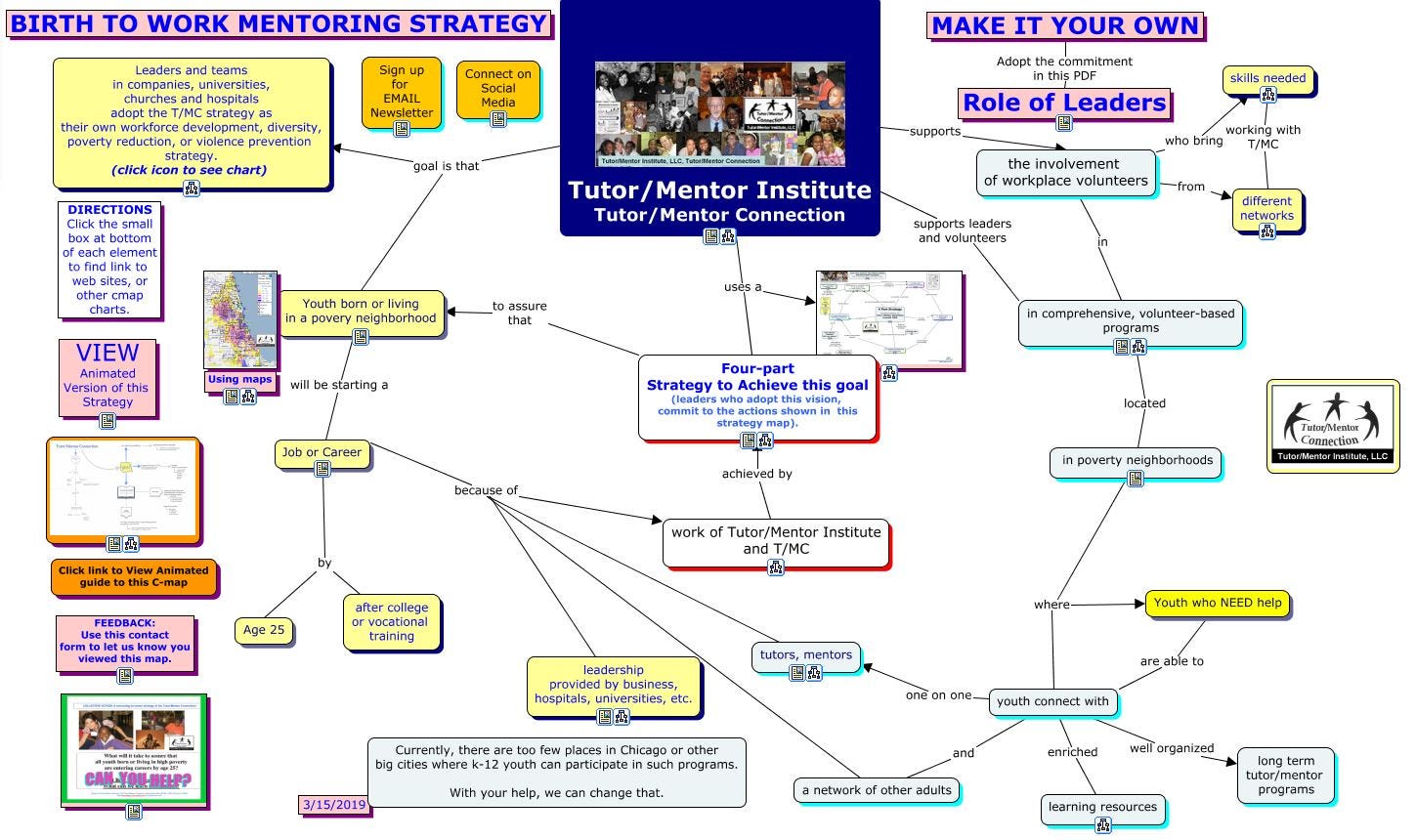
I liked what it provided, but said “Look at this blog article. Add anything from it that expands on the description you provided based on the concept map.
Then I said “Now combine the two explanations into a single description.” Below is the result:
… begin Gemini version …..
The TMC (Tutor/Mentor Connection) Strategy Map, developed by Daniel Bassill of the Tutor/Mentor Institute, LLC, serves as a visual “blueprint” for community and workforce development. Much like an architect’s drawing, it provides a structured framework to help youth in high-poverty areas navigate the long-term journey from birth, through school, and into adult jobs and careers.
This strategy is visualized in the Concept Map (http://tinyurl.com/tmc-strategy-map) and further detailed in the blog article “Enough is Enough. Adopt this Strategy to Help Youth” (https://tutormentor.blogspot.com/2021/05/enough-is-enough-adopt-this-strategy-to.html). Together, they outline the following core pillars:
1. Leadership and Vision (The Top)
The strategy begins with a formal commitment from a leader—whether a CEO, university president, faith leader, or elected official. The map includes a “blue box” at the top intended for a leader to place their own name or logo, signaling they have adopted this vision as a strategic priority. The blog emphasizes that this is a long-term commitment, requiring leaders to renew their support annually for a decade or more to ensure a stable support “pipeline” for youth.
2. The Four-Part Execution Strategy
To turn vision into reality, the map and blog outline a continuous cycle of action:
Information Gathering: Mapping and identifying all existing tutor/mentor programs within a city to identify where “service deserts” exist.
Public Awareness: Using a leader’s visibility and media influence to draw attention to the need. The blog suggests a “video challenge” where leaders record themselves “reading” the map to signal their commitment to their followers.
Resource Distribution: Driving volunteers, donors, and tech resources directly to programs operating in specific high-poverty neighborhoods.
Continuous Improvement: Providing programs with the ideas and support needed to become “mentor-rich,” ensuring they have the staff and quality required to retain youth and volunteers over many years.
3. The “Village” of Stakeholders (The Right Side)
The map visualizes the recruitment of “workplace volunteers” from various professional sectors. The blog expands on this by categorizing these stakeholders into “Village Clusters,” such as the legal, medical, business, and faith communities. The goal is to move beyond simple charity toward a coordinated system where every professional sector uses its unique resources to support comprehensive K-12 programs.
4. The Logic of Support (The Left Side)
The left side of the map functions as a “script” for advocacy. It follows a logic flow starting with the goal (”My goal is...”) and moves through the realization that individual efforts are not enough. It posits that a “village” of support is required to overcome the systemic challenges of poverty, inequality, and the wealth gap.
5. Accountability and Scalability
The strategy is designed to be geographically universal—applicable to any city experiencing concentrated poverty. By encouraging leaders to display this map on their own websites, the Tutor/Mentor Institute aims to create a network of accountability. This allows the community to see which leaders have moved beyond rhetoric and have committed to a specific, visualized plan for poverty reduction and workforce diversity.
Summary of Purpose
Ultimately, the TMC Strategy Map is a tool for aggregation and alignment. It seeks to move a city’s various stakeholders from isolated acts of kindness toward a unified, “mentor-rich” ecosystem that supports youth through every stage of their development.
Then, I said, “You are the CEO of a large manufacturing company located in Chicago. Turn what you have written into a presentation given by the CEO to a meeting of CEOs from many different industries and different companies.
…. end Gemni ……
I posted the response on Medium, because it has a feature that allows you to “listen” to the article. If you want to read the entire sequence of prompts and responses visit this page.
I’d love to see this converted to a video, with an animation showing the CEO delivering the speech. Better yet, I’d love to see a video by someone who actually delivers the speech!
That could be anyone!
Look at the newsletter page again. YOU could be facilitating this conversation. So could youth in middle, high school and/or college.
You could be asking Gemini or other AI platforms to look at any of my blog articles or concept maps, and creating your own interpretation, as well as a new script for you to use and share.
My own experiences leading a single tutor/mentor program from 1975 to 1992 and a second program from late 1992 until mid 2011 drive my passion and make me a credible advocate for cities building and sustaining volunteer-based tutor/mentor programs.
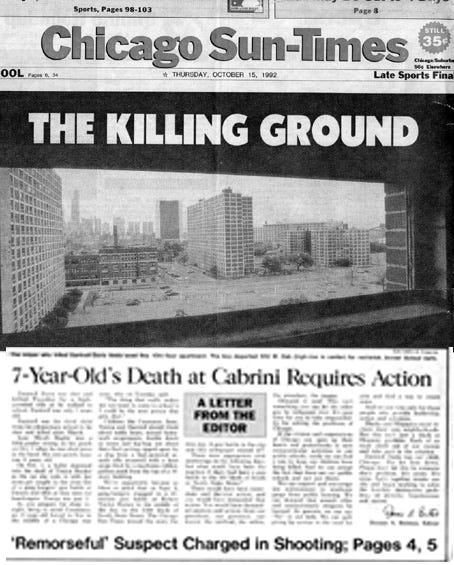
The other thing driving my work is this front page from the October 15, 1992 Chicago SunTimes, following the shooting death of a 7-year-old boy in Cabrini Green. The headline says "7-Year-Old's Death at Cabrini Requires Action".
While I piloted this strategy in Chicago, every major city in the USA and the world has pockets of concentrated poverty. That won’t change with short term solutions or occasional front page editorials.
Thanks for reading this, and, hopefully, sharing it. If you record yourself giving this speech, please send me a copy so I can share it. If you create a page showing yourself/or your company, in the blue box at the top of the concept map, I want to see it.
You can find me on most social media platforms. This page shows where.
Finally, while I don’t charge a fee for you to read my articles, I do have a page where people can contribute to help pay the bills.